Divest installation - New Materialism exhibition


Kath Fries, Divest, 2014, beeswax and ash installation, detail view

Divest is an installation of beewax and ash, which I created for the New Materialism PhD exhibition at Sydney College of the Arts Galleries, Rozelle NSW. This work is being exhibited in accompaniment to the SCA Grad School Conference, Tuesday 9 September 2014, where I presented my paper Beeswax – an ancient material in contemporary art


Kath Fries, Divest, 2014, beeswax and ash installation


New Materialism is an emerging trend in 21st century thought in several fields of inquiry, including philosophy, cultural theory, feminism, science studies, and the visual arts. Defined around the primacy of matter and its properties and actions, the New Materialism re-works long-held assumptions about the nature of the stuff of the universe. It responds to the need for novel accounts of agency, nature and social relationships in the contemporary epoch, when new questions have arisen about our place as embodied humans in the world and the ways we produce, reproduce and consume our material environment. In this challenge to invent new ways to understand the contemporary world, the visual arts have a special place given their concern with the manipulation of matter. For the artist or craftsperson in the studio or workshop, New Materialism can articulate and give agency to existing creative processes, and offer opportunities for new modes of authorship and expanded interpretations of materials and objects and our relationships with them.

Kath Fries, Divest, 2014, beeswax and ash installation

My interest in New Materialism relates to its consideration of non-human creatures, and all matter, as existing in an interconnected and constantly fluid state of flux, flow and change. This challenges conventional western notions of nature as a separate series of inert stable entities to be exploited by superior humans. The New Materialism discourse sees one of its tasks as creating new concepts and images of nature that affirm matter’s immanent vitality.


Kath Fries, Divest, 2014, beeswax and ash installation

This call to rethink how we use and abuse our natural environment, to shift our human-centric focus to consider that non-human things exist for their own ends and have not evolved for human use, is conveyed in the New Materialism re-purposing of the word ‘materiality’ to mean a ‘process’ rather than a ‘thing’.*

Kath Fries, Divest, 2014, beeswax and ash installation

Working with a ‘process’ of materiality, which is impermanent and unstable rather than a static series of separate things, is a notion that resonates in my practice. For me, this process is about reconciling myself with my surroundings and the world’s inescapable natural cycles of life and death, destruction and renewal. Since of the death of my father in 2009, most of my work has in some way related to grieving and reflecting on death as a natural unavoidable part of life. In turn, my aim to cultivate an awareness of the vitality of everyday existence reflects a number of ecological issues and concern for the way that we all often feel inherently separated from nature. I respond to this by working with a contemplative process that focuses on embodying sensory experiences of my surroundings, particularly the fragility and flux of time and materiality.

Kath Fries, Divest, 2014, beeswax and ash installation

Divest consists of small empty beeswax funnels clustered across the wall and smattered with ash, suggesting abandoned containers of life, hollow shells soon to disintegrate. Made by wrapping warm pieces of beeswax around my fingers in a healing bandaging gesture, the funnels are then pressed into the wall in barnacle like clusters, clinging together at various angles. Impressions of my fingers remain on the wax surfaces, even as they become cold and brittle.

Kath Fries, Divest, 2014, beeswax and ash installation, detail view

Embedded in the work is the symbolism of the materials themselves, the beeswax speaks of the hive, the bees’ honeycomb home, as a nurturing life force for the bees and their vital role in ecosystems. The ash is a symbol of grieving, ritual and cremation.


Kath Fries, Divest, 2014, beeswax and ash installation

The ways the honeybees build and adjust their wax-comb designs responses directly to the colony's' changing needs, and is integral to the communication and successful functioning of the super organism that is the beehive. All elements of the hive – worker bees, forager bees, queen bee, larvae, baby bees, drones, wax comb, temperature, form and space, nectar, honey and pollen – are interconnected and interdependent. The complex ecology of the world can be likened to the super organism of a beehive, where humanity is like a few foraging honeybees that cannot survive alone, separated from nature, outside the hive.


Kath Fries, Divest, 2014, beeswax and ash installation

My interest in the ways that we can understand an embodied engagement with time, materiality and nature, through the sensory experience of art, reflects New Materialism’s vitality. This takes a positive approach to the potential for change in human attitudes, proposing that we have the intelligence and creativity to re-engage with nature, and the complex interconnections of our world.


* Maurizia Boscagli, Stuff Theory: Everyday Objects, Radical Materialism (London: Bloomsbury Publishing, 2014). P 13


Kath Fries, Divest, 2014, beeswax and ash installation

 For more information on the 2014 SCA Graduate School Conference & Exhibition New Materialism see  sydney.edu.au/sca/research/new-materialisms 
The exhibition continues to 27 September 2014, open Monday to Saturday 11am - 5pm


Divest, beeswax installation - work in progress

Kath Fries, Divest, 2014, beeswax and ash on wall

Divest traces embodied experiences of impermanence and instability through the tactile material qualities of beeswax and ash. Reflecting on the passage of time and fragility of life, these barnacle-like beeswax forms suggest notions of sanctuary, healing and containment, while the smattered layers of ash conjure feelings of unease and vulnerability.

Kath Fries, Divest, 2014, beeswax and ash on wall, SCA studio
Kath Fries, Divest, 2014, beeswax and ash on wall
Kath Fries, Divest, 2014, beeswax and ash on wall, SCA studio
Kath Fries, Divest, 2014, beeswax and ash on wall, SCA studio 

Divest will be installed in the SCA Gallery for the New Materialism exhibition, 9 - 26 September 2014.
Sydney College of the Arts, Park Drive, Lilyfield NSW (enter opposite Cecily Street) sca.galleries@sydney.edu.au

New Materialism exhibition invitation, SCA Gallery
Kath Fries, Divest, 2014, beeswax and ash on wall
Kath Fries, Divest, 2014, beeswax and ash on wall, SCA studio

Taper - installation for BUNKERED

Kath Fries, Taper, 2014, beeswax, twine, tree roots and light bulb

Bunkered “… responds to the dystopic landscape of a climate-changed future within the context of a domestic dwelling. The term bunker can mean a fortification, a shelter, a storage area for provisions, and a difficult situation. While encompassing all of these layered meanings, to be ‘bunkered’ also suggests a reaction to external forces that are threatening and are ultimately unpredictable. In Bunkered, a dynamic of dialectic oppositions is set: fortifications can fail, shelters can be permeated, stored items can be lost and difficult situations can be mitigated. Containing all of these oppositions is the encompassing figure looming large in the exhibition – that of the house. Suggesting comfort, warmth, protection and security, the domestic context is placed at the forefront of the Bunkered concept. The artists explore how the notion of a home could change when its surrounding environment is toxic.
In this way Bunkered forges a corporeal relationship with the notion of home in a climate-changed world. In mapping this future on a house, we also map these results on ourselves.
… The sense of danger reaches a heightened state in Kath Fries’s attic installation, Taper. The attic, according to Bachelard is a space where “fears are easily ‘rationalised’…”, however here Fries inverts this place to one where fears are realised. Resembling a malevolent parasitic plant, Taper’s root-like tentacles permeate the roof and remind us that this shelter will soon be reclaimed to the new natural forms that have adapted to the altered climate. 
… We are invited to speculate on a future way of life in an entirely familiar way - through the living room, kitchen, bathroom and bedroom. By placing the concept within a lived environment, we experience the potentials of climate change not in the arms length relationship of a gallery setting, but rather up close, personal, with all of the sights, sounds and smells of a domestic context… Bunkered gives us the space to ask how we will relate to our notion of home when we are confronted with the psychological and emotional ramifications of life in a toxic climate, and ultimately questions, how will we live?"

Yvette Hamilton 
The House, the World

Kath Fries, Taper, 2014, beeswax, twine, rope, tree roots and light bulb

BUNKERED ARTISTS: Aaron Anderson, Lisa Andrew, Sarah Breen Lovett, Kuba Dorabialski, Kath Fries, Yvette Hamilton, Anna Horne, Rachael McCallum, Sarah Nolan, Office Feuerman, Katy B Plummer, Madeleine Preston, Marlene Sarroff and Lotte Schwerdtfeger.

BUNKERED
6 - 27 September 2014
Open: Thursday to Saturday 2-5pm
26 Ross Street, Forest Lodge, NSW 2037
www.branch3d.com.au

Opening Event: Saturday 6 September, 4-7pm (tickets)
Artcycle tours: every Saturday
Artist talks: Saturday 20 September, 2.30pm

BUNKERED is curated by Sarah Nolan, with an exhibition essay by Yvette Hamilton, and presented by BRANCH3D Gallery as part of Sydney Fringe Festival 2014

Taper - work in progress for BUNKERED exhibition

Kath Fries, Taper - work in progress, 2014, beeswax, twine, tree roots and light bulb

BUNKERED is a group exhibition situated in an inner city terrace, which contemplates life in a climate-changed future. Fourteen artists are creating works that challenge traditional relationships to domestic spaces.

Kath Fries, Taper - work in progress, 2014, beeswax, twine, tree roots and light bulb


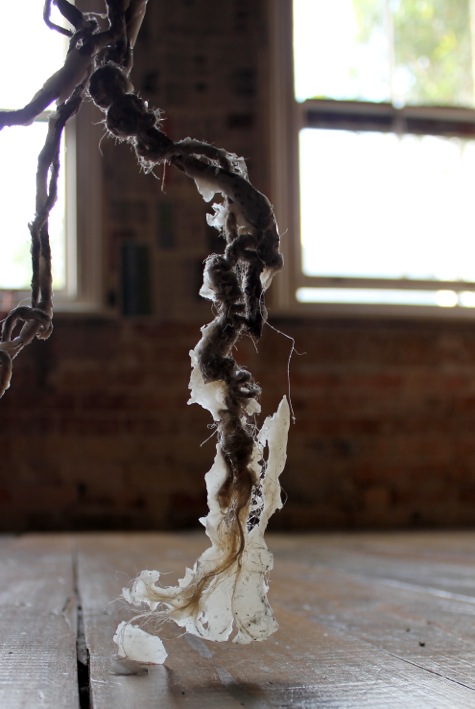
Located in the BUNKERED attic, my installation Taper features entwined roots that dangle dripping with congealed beeswax. They stretch down from the pitched darkness, through the ceiling beams, towards a solitary dim light bulb. The roots are dead, dried and fragile, trickled with beeswax and wrapped in twine, some are almost fossilised into stalactites.

An attic purports to be safe haven, the room furthest from the street and closest to the sky, an enticing quiet place for humans, flora and fauna seeking refuge from the outside world. But a garret is also traditionally a place of poverty and madness, where creatures and people eventually meet their demise.

To taper is to gradually grow narrow towards one end, to taper off; and a taper is a thin candle. Located in an internal space that narrows into a pitched roof, where wax stalactites and plant roots hang like upturned candles thinning to a dripped point, Taper implies that escape is impossible. Uncontainable toxins and pollutions leach through the earth and air, seeping into our interior spaces to potentially poison all aspects of our lives.

Kath Fries, Taper - work in progress, 2014,
beeswax, twine, tree roots and light bulb

BUNKERED ARTISTS: Aaron Anderson, Lisa Andrew, Sarah Breen Lovett, Kuba Dorabialski, Kath Fries, Yvette Hamilton, Anna Horne, Rachael McCallum, Sarah Nolan, Office Feuerman, Katy B Plummer, Madeleine Preston, Marlene Sarroff and Lotte Schwerdtfeger.

BUNKERED
6 - 27 September 2014
Open: Thursday to Saturday 2-5pm
26 Ross Street, Forest Lodge, NSW 2037
www.branch3d.com.au

Opening Event: Saturday 6 September, 4-7pm (tickets)
Artcycle tours: every Saturday
Artist talks: Saturday 20 September, 2.30pm

BUNKERED is curated by Sarah Nolan, with an exhibition essay by Yvette Hamilton, and presented by BRANCH3D Gallery as part of Sydney Fringe Festival 2014

Download the Bunkered catalogue

The opening afternoon, Saturday 6 September, 4-7pm, is a free registered ticketed event. Tickets are available through Eventbrite. There will be six half hour timeslots scheduled for groups of up to 18 people visiting at a time. The meeting point is Forest Lodge Hotel, 117 Arundel Street, where BUNKERED volunteers will give you a designated time to visit the exhibition. All other opening times will not require a ticket, Thursday to Saturday 2-5pm until 27 September.

Bunkered exhibition invitation

2014 John Fries Award opening invitation

It's my pleasure to invite you to the opening of the 2014 John Fries Award finalists exhibition: 6pm, Tuesday 12th August, UNSW Galleries, cnr Oxford St & Greens Rd, Paddington, NSW. 


The 2014 John Fries Award finalists are: Abdul Abdullah, Justin Balmain, Ella Barclay, Tim Bruniges, Julian Day, Omar Chowdhury, George Egerton-Warburton, Marc Etherington, Hamishi Farah, Heath Franco, Samuel Hodge, Anna Horne, Juz Kitson, Anna Kristensen, Bridie Lunney, Daniel McKewen, Beryline Mung, Ramesh Mario Nithiyendran, Alair Pambegan, Kate Scardifield, Marilyn Schneider, Jacqui Shelton, Jason Wing and Kentaro Yamada.
To preview their work go to www.viscopy.org.au/jfa 

Solace installation 2014 - SCA studio

Kath Fries, Solace, 2014, beeswax on window, sunlight and shadow, SCA studio

Recently, I've been continuing my Solace series of installations in my studio at Sydney College of the Arts, Rozelle. Working with sheets of beeswax to create patterns with transient sunlight and shadows, like a sundial, this work traces the passage of time. 

Kath Fries, Solace, 2014, beeswax on window, sunlight and shadow, SCA studio

Beeswax is a material in a constant state of flux, changing from brittle to malleable and opaque to translucent, with just a few degrees difference in temperature. When warmed beeswax gives off a delicious honey scent and reminds me that people all over the world have worked with bees, their hives, wax and honey since ancient times.

Kath Fries, Solace, 2014, beeswax on window, sunlight and shadow, SCA studio

The wax patterning in Solace links back to the structure of the hive where the beeswax originated, and where worker bees danced on it in precise figure-eight shapes to communicate the location of pollinating flowers in relation to the position of the sun. 

Kath Fries, Solace, 2014, beeswax on window, sunlight and shadow, SCA studio

Solace reflects on the passage of time, moment to moment as the shifting angles of sunlight penetrate the interior space. It also looks back to a long historical relationship between humans and bees, implying concern for the future and our complex, fragile intricate interconnections with both our micro and macro environments.

Kath Fries, Solace, 2014, shadow - detail view, SCA studio

Kath Fries, Solace - trace, 2014, beeswax on window, sunlight and shadow, SCA studio

Kath Fries, Solace - trace, 2014, beeswax on window, sunlight and shadow, SCA studio

Previous versions of Solace were installed last year at Murrary's Cottage in Hill End and also at Archive Space in Newtown, link.

John Fries Award 2014 - finalists announced


The 2014 John Fries Award finalists are: Abdul Abdullah, Justin Balmain, Ella Barclay, Tim Bruniges, Julian Day, Omar Chowdhury, George Egerton-Warburton, Marc Etherington, Hamishi Farah, Heath Franco, Samuel Hodge, Anna Horne, Juz Kitson, Anna Kristensen, Bridie Lunney, Daniel McKewen, Beryline Mung, Ramesh Mario Nithiyendran, Alair Pambegan, Kate Scardifield, Marilyn Schneider, Jacqui Shelton, Jason Wing and Kentaro Yamada.


The winner of the 5th John Fries Award will be announced at 7pm, Tuesday 12 August at the Finalists Exhibition,  Galleries UNSW, COFA in Paddington, Sydney.

Sebastian Goldspink (the 2014 JFA guest curator and judge), said “The calibre of entries for this year’s award set a new standard. I was surprised, delighted and slightly overwhelmed by the prospect of whittling down the record 546 entries to a shortlist of 88, and then, with my fellow judges, to the 24 finalists. There was a genuine sense of excitement in the judging room.”

The finalists come from all over Australia and New Zealand, and their work includes painting, sculpture, installation, video and a live performance work.

“The John Fries Award always delivers something unexpected,” says Goldspink. “The artists display extraordinary imagination and take risks and I know everyone will be keenly watching and waiting for this year’s exhibition at Galleries UNSW, COFA."
"It's a fantastic celebration of the strength and diversity of Australasian emerging art!”

The prize was established by the Fries family in memory of former Viscopy director and honorary treasurer, John Fries, who made a remarkable contribution to the life and success of the organisation.

Judges for the 2014 award are: Sebastian Goldspink, Alexie Glass-Kantor, Jess Olivieri, Kath Fries and Megan Cope. 
JFA 2014 sponsors include: International Art Services, 10 group, Little Creatures Brewery and Small Acres Cyder.

Chippendale New World Art Prize, 8 - 24 May 2014

I'm one of the finalists in the 2014 Chippendale New World Art Prize, opening Thursday 8th May 6-8pm. The selected artworks all respond to the theme of Utopia, individual perceptions and interpretations of a 'New World'.

Chippendale New World Art Prize invitation

Philanthropist and Chairman of Frasers Property Australia Dr Stanley Quek will announce the winner at 7pm. Judged by Archibald Winner Del Kathryn Barton and Dean and Director of COFA Ross Harley, the prize is a three month residency grant at Joya:arte+ecología in Spain.

The exhibition will span three locations: NG Art Gallery; L1 Central Pop Up Gallery; Carlton Street, Park Lane Pop-Up Gallery. www.chippendalecreative.com/2014-chippendale-new-world-art-prize-finalists

Chippendale New World Art Prize map of locations and artists

My entry, Whisper conjures a yearning for continuous serenity, which can sometimes be found - only momentarily - in the quiet contemplation of nature. This self-contained intimate installation features a dissected clay vessel containing video footage of water flowing slowly past a tranquil riverbank, reflecting the trees and sky above. Externally this dull brown clay object is as unremarkable as the mythical genie’s bottle, camouflaged as everyday clutter and quickly dismissed by a casual passer-by. But projected within the vessel there is a continuous moment of quiet mediative contemplation, an idyllic notion of Utopia where one is able to attain this human desire to be at one with nature. Whisper’s hand-made, hand-sized receptacle lends a personal embodied notion of physically touching and holding this particular moment of engagement with the natural world. The video’s looped repetition takes this moment out of the flux and flow of time as we usually experience it. Heraclitus, an ancient Greek philosopher, said that you can never step in the same river twice, yet thousands of years later we still continue to aspire to pause the passage of time and search for a permanent state of perfection.

Kath Fries, Whisper, 2014
you can view the video component on line vimeo.com/92002590

Whisper will be exhibited at Carlton Street Park Lane Pop-Up Gallery, 8 - 24 May, as part of the Chippendale New World Art Prize. 

Call for entries - 2014 John Fries Award

The 2014 John Fries Award is currently calling for entries. The entry criteria has been simplified this year, so if you consider yourself to be an emerging or early career artist then you're eligible to enter. 

John Fries was my father. He worked pro-bono for some not for profit organisations, including Viscopy as treasurer and board director. The John Fries Award was initiated in 2009 by the Viscopy Board of Directors and my family. Viscopy/Copyright Agency runs the award and the 2014 Finalists Exhibition will be held at UNSW Galleries CoFA in August. I'm currently on the Viscopy Board, chair the John Fries Award committee and on the judging panel.


To enter and find out more go to www.viscopy.org.au/john-fries-award - entries close Monday 5 May 2014.


2014 John Fries Award call for entries poster (artwork by Svetlana Bailey, 2013 finalist)

John Fries, 1943 – 2009

John was born in Dehra Dun, India, 10 March 1943. He recalled his early childhood impressions of living in Calcutta with a Rudyard-Kipling-like magical aura. When India gained independence in 1947, the Fries family, along with most Anglo-Indian’s, felt compelled to leave India. After much discussion they decided to move to Australia and the family settled in Coogee. As fledgling fresh-off-the-boat immigrants, John and his brother explored their unfamiliar neighbourhood with glee, on land and in the water. John learnt to swim in the Pacific Ocean at Coogee Beach and Wiley's Baths – he became a strong swimmer and beach enthusiast for the rest of his life. John attended Coogee Boys Prep School then Sydney Boys High School, where his ambitious nature became apparent in his studies and competitive team sports, especially rugby and rowing. John's love of physical activities extended to skiing, hiking, kayaking and cycling – even in retirement he was meticulous about recording and besting his own personal times and distances.

John began his career in the finance industry as a commercial trainee with BHP, while holding down additional jobs and attending night school at UNSW where he gained an Honours Degree in Commerce. John met his future wife Vivienne when travelling to America in 1970. They subsequently had many adventures together, working and travelling both in the USA and UK, then touring Europe in a green kombi van, affectionately named The Flea - a cherished vehicle despite its numerous breakdowns. In 1974 they returned to Australia, married and had two daughters, Vanessa and Katherine. John and his young family moved back to London in 1984, where John was appointed the International Treasurer for TNT. During their four years in London the family embraced the city’s arts and culture, snowy winters and proximity to Europe - often travelling there for holidays. In 1988, the family moved back to Sydney, where John became Finance Director for MacIlwraith McEacharn. As well as focusing on his career, John encouraged Vivienne’s interests in pursuing university studies and charity work aboard, while he took over some domestic chores and responsibilities of teenage daughters. At this time John also became a Justice of the Peace, but whether that helped in family disputes is debatable. John was by then the National Finance Director for Vodafone, seeing Vodafone through their initial growth spurt as the mobile phone industry gathered momentum, 1993-2000.

John was a keen traveller for work and holidays throughout his life; visiting Papua New Guinea, Sri Lanka and South Africa; cycling in Vietnam, Tasmania and New Zealand. He chased the snow around the globe - skiing in the Dolomites, Pyrenees, Sierra Nevada’s, Japan, European Alps, New Zealand and The Rockies. John and Vivienne followed the Rugby World Cup to Europe in 2007, although he supported the Wallabies and Vivienne barracked for the All Blacks. They also spent many holidays in Vivienne’s hometown of Nelson, New Zealand, which became a second home for John. At 63 he undertook a much-anticipated intrepid adventure with an old friend, along the Silk Road from Beijing to Moscow. The following year John sailed across the Tasman, from Sydney to Auckland, part of a three-man crew captained by his mate from high school. John said this was one of the most physically, emotionally and mentally challenging experiences of his life.

As well as travelling, on retirement John became involved in Rotary focusing on fundraising for international projects, and was invited to become an independent director for a number of organisations, including pro-bono positions with Viscopy and the NSW Red Cross. In 2000, John brought his financial expertise and pro-active rigour to his work at the Red Cross. His commitment to the humanitarian principles and altruistic ideals of the Red Cross, lead to him being appointed NSW Chairman in 2007 and a Director on the National Red Cross Board. John received a posthumous Red Cross Distinguished Service Award in October 2009.
John’s unexpected and tragic death in 2009 deeply affected his family, friends and colleagues. Both NSW Red Cross and Viscopy established annual John Fries memorial awards in 2009. And in 2010, the Rotary Club of Darling Harbour completed their fresh water well project in Nimpith, West Bengal. It was dedicated The John Fries Memorial Well – as John had been pivotal in the fundraising for this project.

The John Fries Award for Emerging Visual Artists was jointly initiated by the Viscopy Board and the Fries family, in recognition of the formative influence that John had on the development of Viscopy. John was invited to join the board of Viscopy in 2004 because of his financial expertise and business skills. Although he had always been broadly interested in arts and culture, John’s interest in contemporary visual arts related mostly to his daughter’s art practice. As an accountant with extensive experience in the corporate environment, John’s contributions to the Viscopy board were anchored in his realistic and forward-looking attitude and his empathetic understanding of the financial challenges that face visual artists. The Fries family continues to work with Viscopy in building this award, commemorating John’s generosity and his pragmatic approach to supporting his family, friends and colleagues in developing their skills, exploring opportunities and pursuing their dreams.
Kath Fries, 2014
www.viscopy.org.au/john-fries-biography

John Fries at the beach in 2006, photo by Kath Fries

RIGHTNOW - supporting artists resale royalty rights

I'm participating in RIGHTNOW - an exhibition of work by 100 Australian artists supporting the Artists' Resale Royalty Scheme. 

RIGHTNOW exhibition invitation, artwork: David Frank, Ngura.

RIGHTNOW9 - 27 April 2014
Boomalli Gallery: 55-59 Flood St, Leichhardt
Artists include: Adam Hill, Adam Norton, Alan Jones, Alec Baker, Anne Zahalka, Anthony Bennett, Anthony Lister, Arone Meeks, Atipalku Intjalki, Betty Muffler, Bronwyn Bancroft, Bruce Parker, Bugai Whyoulter, Chris Horder, Craig Waddell, Dadda Samson, Dan Hollier, Danny Eastwood, David Frank, Derek Thompson, Dianne Robinson, Douglas Abbott, Gloria Pannka, Gria Shead, Helen Samson Dale, Hilary Wirri, Ivy Pareroultja, Jakayu Biljabu, Jake Soewardie, James Drinkwater, James Guppy, Jamie Eastwood, Jason Benjamin, Jason Wing, Jasper Knight, Jatarr Lily Long, Jennifer Whiskey, Jenny Fraser, John Aslanidis, John Wolseley, Juan Ford, Judith Samson Anya, Julian Meagher, Kath Fries, Kerry Anne Robinson, Kevin Wirri, Laura Jones, Lenie Namatjira, Luke Cornish, Luke Sciberras, Mabel Wakarta, Maisie King, Mandy Martin, Marie Abbott, Mark Rodda, Martine Emdur, Matthew Johnson, Melinda Harper, Mervyn Rubuntja, Michael Johnson, Ngunytjima Carroll, Nicholas Harding, Nora Nungabar, Nora Wompi, Nyarrie Morgan, Peter Alwast, Peter Mungkuri, Peter Taylor, Petrina Hicks, PhilJames, Reg Mombassa, Remnim Alexander Tayco, Renita Stanley, Robert Boynes, Rosalind Tjanyari, Selma Coulthard, Tiger Yaltangki, Ungakini Tjangala, Whiskey Tjukangku and artists from the Tangentyere, Tjala Arts and Maningrida.

Please support the artists' resale royalty scheme by visiting the exhibition or signing the online petition www.resalerightnow.wordpress.com/sign-the-petition/


The Artist Resale Royalty Scheme began in Australia in June 2010, enabling artists to receive 5% income from their artworks when resold. The scheme was reviewed last year and it now seems that the current Federal Government wants to scrap it. One of the main reasons the scheme was brought into law was to support Aboriginal and Torres Strait Islander artists who often sell their artworks for very low sums of money - so while their artworks may have increased in value, the artists didn't earn any of that revenue. Many of these artists live in poverty while their artworks are traded for hundreds of thousands of dollars. 

Since the scheme began it has generated over $2.28 million in royalties for more than 820 artists. Indigenous artists have received 50% of the total royalties generated and represent 26 of the 50 artists who have received the most money under the scheme.