Scorch - accompanying exhibition texts


to render permanent that which is impermanent

The transience of existence and fragility of life are recurring themes throughout my practice. I use natural materials like twigs and charcoal to form a poetic commentary on human relationships with nature and our personal struggles to accept what is natural and uncontrollable in our lives.

Kath Fries, Hold dear (detail view), bronze, nylon and charcoal,
installed at galleryeight. Photograph by Peter Cramer.

The sculptural pieces in this exhibition suggest metaphoric narratives of our fallible human endeavours to hold together and immobilise moments of growth, decay and memory. Hold dear (2011) reflects on the human grieving process and the challenge of emotionally letting go of loved ones after they pass away. A bronze cast magnolia branch protrudes out of the wall, tied with black nylon netting that stretches across the space to seemingly drag a mound of burnt wood along the floor. The strength of the branch, tension in the netting and dead weight of the charcoal infers a poetic commentary about our human resistance to natural cycles of aging and occurrence of death.

The bronze twigs in Scorch (2012) are balanced precariously, simultaneously fragile and resilient, marking a pause in time between the fiery furnace that formed them and a future moment of unravelling and succumbing to gravity. The word ‘scorch’ conveys tangible quick impact and flinching response, describing a fleeting moment that has past rather than the present remnant objects of the final artworks. As such Scorch and Hold dear trace futile attempts to render permanent that which is impermanent, echoing the recurring pursuit of contradictory endeavours in our lives.

Kath Fries, March 2012
Artist statement, Scorch exhibition

The artist would like to thank:
The NSW Artists’ Grant initiative and NAVA, Peter Cramer, Megan Robson, Vivienne Fries, Arnel Rodriguez, Crawford’s Casting South Strathfield, The ArtStart Grant program and The Australia Council for the Arts, Parramatta Artists Studios, Sydney College of the Arts The University of Sydney, The Lord Nelson Hotel, Art Month Sydney and galleryeight.

..................................................................................................

SCORCH: Kath Fries solo exhibition
2 - 22 March 2012
galleryeight
12 Argyle Place, Millers Point, NSW 2000

..................................................................................................


Kath Fries, Hold dear, bronze, nylon and charcoal,
installed at galleryeight, photograph by Peter Cramer


the world that we know

The world that we know is reconfigured and remade in the work of Kath Fries. In her artworks, which encompass artist’s books, installation, painting, photography and sculpture, we are taken to another place, one in which familiar objects are transformed into something unrecognisable and unexpected. She creates situations that play with assumed behaviours and expectations to consider human relations and our interaction with the natural world. In the exhibition, Scorch, Fries considers the futility of attempting to try to influence the progression of time. Presenting a major sculptural installation, Hold dear (2011), and a new body of work, Scorch (2012), the artist explores ideas around the progression of life and the nature of memory.

Much of the Fries’ practice is ephemeral in nature, she frequently works within public or outdoor spaces, in which the work is subject to both natural and human interaction, and uses organic materials, such as coal, wood, feathers and flora, which deteriorate over time. The artist documents and re-presents her temporary constructs in the form of photographs and artist’s books. The changing state of the works in both the original context and their subsequent presentation in recorded form, not only emphasises the elusive nature of the work but also reflects life cycles of growth, change and decay. Additionally a consistent trope in the artist’s work is the reinterpretation of elements from previous works. In new works, existing materials and crafted objects from previous artworks take on different roles and meanings. The instability of the artist’s works draws parallels with the nature of the world around us and the fragility of life.

Kath Fries, Hold dear, bronze, nylon and charcoal
installed at galleryeight, photograph by Peter Cramer

Hold dear is a large-scale installation that consists of a large bronze magnolia branch, which appears to have grown through the wall rupturing the enclosed gallery space. Multiple buds are dotted along the branch, tightly closed teasing us with a promise to bloom into metallic blossoms in an unknown future. Wrapped around the branch is a length of black netting trailing down to the gallery floor, weighed down by a mound of black charcoal. A trail of black soot can be seen behind the mound, tracing the path from where it has moved from its original position a short but not insubstantial distance away. There is an ambiguity to the scene that is unsettling. At first it appears that the netting is slowly becoming wound around the branch as it continues to grow encroaching into the white gallery space and pulling the mound of charcoal to be brought closer to the bronze branch. And yet, from a different angle it appears as if the fabric is being used as an anchor in an attempt to restrain the branch. A bronze branch caught by a dead weight.

Site and context play an important role in Fries’ works, informing material, construction and interaction. Additionally, the artist often references folklore, fairy tales and historical myths in her works, exploring representations of daily life and the real world within fictional constructs. Referencing familiar counterpoints such as a story from childhood or an architectural feature of the site, she creates situations that evoke particular sensations and personal memories. Through such devices her works create their own elusive narrative, seeming to be both of this world and at the same time entirely foreign. In this exhibition, Fries challenges the assumed distinction between the gallery environment and the external world. By presenting material that appears to have physically permeates the sterile white environment, the artist draws broader observations about attempts to restrict and control unstable life forces.

Kath Fries, Scorch series, bronze, twine and charcoal
installed at galleryeight, photograph by Peter Cramer

A series of small bronze magnolia branches are suspended from the wall in the artist’s new series of works, titled Scorch. Some of the branches are tied up with twine, others with weights of coal hanging like pendulums. Other branches are left bare, but look like desolate trophies, undignified and completely removed from their natural environment. Where twine is wrapped around the branch, it appears to be an attempt to restrict or control their growth. There is a sense that twine and charcoal ballasts have, if not proved futile, only minor impositions to the growth of the young branches. For despite any similarity the specimens may initially exhibit on close inspection it is apparent that each branch is completely unique. As the line-up of twisted organic shapes in Scorch illustrates no attempt to tame or subdue time can control life, or death.

In Hold dear and Scorch, Fries has used a direct casting technique which creates a unique replica of the living magnolia branches. The very process of casting an object in bronze is one that demands an act of destruction to create the finished artwork. To create the bronze casts a mould is made around the branches, which are burnt out when the molten bronze is poured into the moulds. It is then the act of attempting to as the artist notes ‘render permanent that which is impermanent’ which enforces the impossibility of such a task. Although the bronze is an exact copy, the original living form no longer exists and all that remains is a static object.

The magnolia branches scattered with small buds, are representative of life and its possibility. In creating a bronze cast of the branches at this particular moment, Fries draws our attention to both life and death. The branches, now permanently immortalised at moment in which they are on the verge of blossoming with new life, are a symbol of the fleetingness of time and the cruelty of creation.

In the exhibition Scorch, Kath Fries’ brings inanimate objects to life. In these tableaus the objects do not simply represent living objects but were once themselves independent living forms. In this way the objects are both selected and arranged in reference to this  conceit. In this regard the exhibition is a memorial to time. The works, Hold dear and Scorch, meditations that change is inevitable despite human persistence to halt its progress.

Megan Robson, March 2012
Catalogue essay, Scorch exhibition


Kath Fries, Scorch series, bronze, twine and charcoal
installed at galleryeight, photograph by Peter Cramer

Scorch series - studio preview & works in progress

These are my new sculptures, titled Scorch series, for my upcoming solo exhibition opening at galleryeight on Friday night. I've had cast magnolia twigs in bronze using a one-off direct casting method (so they are unique pieces not editions) then bound them with twine and suspended pieces of charcoal.

Kath Fries, Scorch i, 2012, bronze and twine, detail view, 60x30x8cm

Kath Fries, Scorch series, 2012, bronze, twine and charcoal, dimensions variable
Scorch explores the idea of trace, in that each artwork is a remnant of the creative process but the actual moment of action has past. These bronze twigs are balanced precariously, simultaneously fragile and resilient. Like a pause in time between the fiery furnace that formed them and a future moment of unravelling, succumbing to gravity.

Kath Fries, Scorch ii, 2012, bronze and twine, 24x28x5cm
Kath Fries, Scorch series, 2012, bronze, twine and charcoal

The transience of existence and fragility of life are recurring themes throughout my practice. I use natural materials like twigs and charcoal to form a poetic commentary on our human relationships with nature and our personal struggles to accept that which is natural. In Scorch my use of cast bronze branches is a reflection on our human efforts to render permanent that which is impermanent.

Kath Fries, Scorch iii, 2012, bronze, twine and charcoal

Scorch exhibition - part of Art Month Sydney


My solo exhibition Scorch at galleryeight is part of Art Month Sydney

Scorch - solo exhibition @ galleryeight

Kath Fries, Scorch exhibition invitation front
Kath Fries
SCORCH
3 - 22 March 2012

Opening night drinks with the artist - Friday 2 March 6pm

Art Month Sydney Event - Sunday 11 March 3pm
Kath Fries in conversation with Megan Robson (Museum of Contemporary Art) and Peter Cramer (galleryeight), followed by complimentary craft beer tasting courtesy of the Lord Nelson Hotel.

galleryeight 
12 Argyle Place, Millers Point, Sydney NSW 2000

Open Tuesday to Sunday 12-6pm www.galleryeight.com.au

Scorch is an exhibition of sculptural installations reflecting on our human efforts to render permanent that which is impermanent. 

Kath Fries explores materiality, spatiality and archetypical narratives by marking a personal, immediate engagement with time, place and physicality. Her work links one’s present experience to boarder considerations of humanity, history and future continuation. The transience of existence and fragility of life are recurring themes throughout her practice.

For this exhibition Fries has cast magnolia branches in bronze and bound them with twine and charcoal to create intriguing assemblages of texture and form. These sculptural pieces suggest emotive narratives of our fallible human endeavours to hold together and immobilise moments of growth, decay and memory.

Kath Fries, Hold dear, 2011, bronze, nylon and charcoal.
Photograph courtesy of Sydney College of the Arts, The University of Sydney


The largest installation in this exhibition is titled Hold dear, implying a reflection on the human grieving process and the challenge of letting go. Fries has created a bronze magnolia branch that protrudes out of the gallery wall. Black nylon netting is wrapped around the branch, stretching across the space to seemingly drag a mound of burnt wood along the floor. The strength of the branch, tension in the netting and dead weight of the charcoal infers a poetic commentary about our human struggles to resist natural cycles of aging and occurrence of death.

Kath Fries graduated from the University of Sydney with a Master of Visual Arts. She won the 2010 Japan Foundation New Artist Award and is a recipient of a 2011 ArtStart Grant from the Australia Council. 

Kath Fries, Scorch exhibition invitation, back

Kath Fries would like to thank Peter Cramer from galleryeight, Megan Robson from the MCA, NAVA and the NSW Artists Grant initiative, The Lord Nelson Hotel, Art Month Sydney, The Australia Council and the ArtStart Grant program, Crawford's Casting South Strathfield, Parramatta Artist Studios and Sydney College of the Arts for their assistance with with this project.

Kath Fries, Hold dear, 2011, bronze, nylon and charcoal.
Photograph courtesy of Sydney College of the Arts, The University of Sydney

Online artwork portfolio - coming soon

My new artwork portfolio website www.kathfries.com will be launched at the opening of my solo exhibition, Scorch, 2nd March 2012, at galleryeight, 12 Argle Place, Millers Point, NSW 2000.
The design and development of my online artwork portfolio is a core component of my ArtStart Grant project, funded by the Australia Council for the Arts more info
... and I intend to continue with this blog too!

Web - new artist book

Web is an open edition artist book of photographs documenting a collaborative project by installation artist Kath Fries and performance artist Patricia Alvarez.

This perforative installation explores Fries and Alvarez's dual interests in challenging voyeuristic dynamics and experimenting with the tactility of fibers to extend and entangle the body.

Presented at Gaffa Galleries Sydney, 24 February 2011, the event was titled Clothe the wold and meet the sky referencing Tennyson's 1833 poem, The Lady of Shallot. 
Similarly the title of this artist book, Web, also relates to famous lines in The Lady of Shallot:
"out flew the web and floated wide
the mirror crack'd from side to side".


Kath Fries' immersive installation of nylon netting and synthetic hair strands, is characteristic of her site-responsive practice, situating everyday and domestic materials to seemingly grow out of the nocks and crannies of an exhibition space. Her exploration of materiality, spatiality, archetypal narratives is extended in this work to invite another person to step beyond the role of passive viewer and actively interact with her work.

The live performance lasted two hours and involved Alvarez singing whilst braiding her own hair into the netting and hair extensions. Her performance continued until she became too ensnared to physically turn her head. At that point when she tentatively shifted position she dragged the whole installation with her, threatening to pull down the entire cave of netting and trap the audience.


If you would like to read more about this collaborative project and see images of the 2011 exhibition, have a look at these earlier posts and critics' reviews:


Strand installation at 4A Members Exhibition 2011

Gallery 4A Annual Members Show 2011, exhibition invitation

The 4A Annual Members' Exhibition
4A Centre for Contemporary Asian Art
181-187 Hay Street, Haymarket, Sydney
15 - 23 December 2011


Each year 4A opens its doors and makes it's walls available to 4A members during the Annual Members' Exhibition. It's a way to thank members and for them to meet and share their creative talents with those who are part of the Asian-Australian cultural discussion.

4A Centre for Contemporary Asian Art is Australia's peak national body for contemporary Asian and Australian art and culture. 4A believes that Asian cultural thinking will have an important impact in the future. We are passionate about creating opportunities for artists and facilitating networks between Australia and the Asia-Pacific Region.


Kath Fries, Strand, 2011, nylon synthetic hair extensions,  electric cord, light bulb, and plinth. Dimensions variable. Detail view of top of work as installed at Gallery 4A

Kath Fries, Strand, 2011, nylon synthetic hair extensions, electrical cord, light bulb and plinth, dimensions variable. Detail view of bottom of work as installed at Gallery 4A.
"Strand is a tangled rope of apparently discarded hair ending in an illuminated light bulb. Human hair provokes polarized responses, in some circumstances it is a beautifying adornment, signalling seduction, but when shed becomes a revolting abject substance tangled in a bathroom drain. In Strand, nylon synthetic hair extensions bind an electrical current, forming a poetic metaphor about intimate connections between people. Like a lover's lock of hair traditionally kept as a memento, or the sense of intimacy (or repulsion), evoked when finding a strand of someone else’s hair on one's skin or clothing. Strand was created whilst artist-in-residence at The Lock-Up Newcastle in April 2011. The transience of existence and fragility of life are recurring themes throughout my art practice. My work explores materiality, spatiality and archetypical narratives by marking a personal immediate engagement with time, place and physicality. I use domestic materials and natural elements to create site-sensitive installations and soft sculptures linking present experience to boarder considerations of humanity, history and future continuation."

Kath Fries, Strand Artist Statement, December 2011


Aqua-librium exhibition documentation

A selection of photographs by Joy and John from Lyrebird Photography taken of my work in the Aqua-librium exhibition at Primrose Park Gallery, Cremorne, 9 - 18 December 2011.

Aqua-librium exhibition gallery view, artwork by Kath Fries and Julie McConaghy.
Photograph by Joy and John from Lyrebird photography.

Kath Fries, Hanging gardens series, 2011,  pantyhose, local weeds and objects, potting mix, water saving crystals and heritage ceiling beams.
Photograph by Joy and John from Lyrebird photography.

Kath Fries, Garden stakes, 2011, pantyhose, found wooden stakes and local weeds.
Photograph by Joy and John from Lyrebird Photography.

Kath Fries, Garden stakes, 2011, pantyhose,  found wooden stakes and local weeds.
Photograph by Joy and John from Lyrebird Photography.

Kath Fries, Hanging gardens, 2011,  pantyhose, weeds, potting mix, water saving crystals and decorative pink potting gravel.
Photograph by Joy and John from Lyrebird Photography.

Kath Fries, Spore gardens, 2011, pantyhose, ferns and potting mix.
Photograph by Joy and John from Lyrebird Photography.


Kath Fries, Slingshot rock garden, 2011, pantyhose and locally found rock and moss.
Photograph by Joy and John from Lyrebird Photography.


Gallery view of Kath Fries' work in Aqua-libirum, including Spore gardens, Strain series photographs and Hanging gardens, 2011.
Photograph by Joy and John from Lyrebird Photography.

Aqua-librium outdoor installations


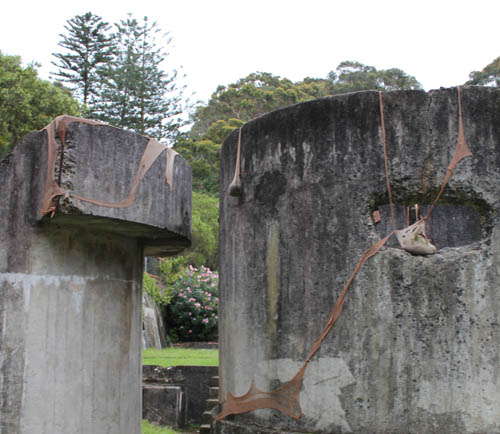
Kath Fries, Strain, 2011, pantyhose, weeds, potting mix, water-saving crystals and heritage structures in Primrose Park, Cremorne.  

As part of the Aqua-librium exhibition, 9 - 18 December 2011, I created an intervention installation on the heritage concrete cylindrical tanks, redolent from the 1890's sewage works. I used pantyhose as a contrasting texture that stretched across the concrete to lead viewers around the structures and support the hanging gardens of local weeds transplanted from around the area. The pantyhose linked back to the site's initial use as North Sydney's first sewage works in its suggestiveness of human skin and underwear.

Kath Fries, Strain, 2011, pantyhose, weeds, potting mix, water-saving crystals and heritage structures in Primrose Park, Cremorne. 

Kath Fries, Strain, 2011, pantyhose, weeds, potting mix, water-saving crystals and heritage structures in Primrose Park, Cremorne.

Kath Fries, Strain, 2011, pantyhose, weeds, potting mix, waters-saving crystals and heritage structures in  Primrose Park, Cremorne.

Kath Fries, Strain, 2011, pantyhose, weeds, potting mix, water-saving crystals and heritage structures in Primrose Park, Cremorne.

Kath Fries, Strain, 2011, pantyhose, weeds, potting mix, water-saving crystals and heritage structures in Primrose Park, Cremorne.

Kath Fries, Strain, 2011, pantyhose, weeds, potting mix, water-saving crystals and heritage structures in Primrose Park, Cremorne.

Kath Fries, Strain, 2011, pantyhose, weeds, potting mix, water saving crystals and heritage structures in Primrose Park, Cremorne.

Kath Fries, Strain, 2011, pantyhose, weeds, potting mix, water saving crystals and heritage structures in Primrose Park, Cremorne. 

Kath Fries, Strain, 2011, pantyhose, weeds, potting mix, water saving crystals and heritage structures in Primrose Park, Cremorne.

Kath Fries, Strain, 2011, pantyhose, weeds, potting mix, water saving crystals and heritage structures in Primrose Park, Cremorne.

Kath Fries, Strain, 2011, pantyhose, weeds, potting mix, water saving crystals and heritage structures in Primrose Park, Cremorne.

Mosman Daily newspaper article


"The work of artist Kath Fries is a playful comment on the gradual cycle of destruction and rejuvenation in the park." 

Mosman Daily, 8 December 2011, page 15
Article by Kate Crawford and photo by Dave Swift  

Strain gallery installations, Aqua-librium exhibition

Kath Fries, Strain, 2011, installation view Aqua-librium exhibition,
Primrose Park Gallery Cremorne, December 2011


My new series of artworks, Strain, has been developed over the past six months during my studio residency at North Sydney Council's Primrose Park artist studio. These works will be exhibited in Aqua-librium: to find a point of balance using the flow of water, at Primrose Park Gallery Cremorne, 9 - 18 December 2011.


Kath Fries, Strain, 2011, installation view Aqua-librium exhibition,
Primrose Park Gallery Cremorne, December 2011


Strain is a series of site-sensitive installations that playfully comment on the gradual cycle of destruction and rejuvenation in Primrose Park. Despite grandiose human attempts to control and order natural elements, tiny weeds can be found growing in the widening cracks of the 1891 sewage works structures. Their roots seek out the natural flow of water that continues to seep down into the harbour, regardless of hundred-year-old efforts to contain and divert the watercourse through concrete canals and aqueducts.


Kath Fries, Strain, 2011, installation view Aqua-librium exhibition,
Primrose Park Gallery, Cremorne, December 2011


In the park, Strain is an intervention installation created from lengths of pantyhose stretched over the rough concrete surfaces to form contrasting textures. This sheer fabric ladders and tears like aging human skin, mimicking the cracks and ruptures across the heritage structures. Knotted and interlinked, disappearing and reappearing, the material leads the viewer around the site like a guiding thread; insinuating internal flows, movements and interconnections.

Kath Fries, Strain, 2011, installation view, Aqua-librium exhibition,
Primrose Park, Cremorne, December 2011


In the gallery, Strain takes the form of sculptures that continue to stretch the pantyhose metaphor. These suspended fabric tubes support a collection of local weeds and objects to create small hanging gardens. Several are bursting at the seams with soaked water-saving crystals, much as the water flowing beneath the park's concrete facades gradually ruptures through to the surface.


Kath Fries, Hanging Garden, 2011, part of the Strain installation,
Aqua-librium exhibition, Primrose Park Gallery Cremorne, December 2011


Kath Fries has a Masters of Visual Arts from the University of Sydney. She was awarded a 2011 ArtStart Grant from the Australia Council and won the 2010 Japan Foundation New Artist Award. The transience of existence and fragility of life are recurring themes throughout her art practice. Fries’ work explores materiality, spatiality and archetypical narratives by marking a personal, immediate engagement with time, place and physicality. She uses domestic materials and natural elements to create site-sensitive installations linking present experience to boarder considerations of humanity, history and future continuation.

Kath Fries, Slingshot rock gardens, 2011, part of the Strain installation,
Aqua-librium exhibition, Primrose Park Gallery Cremorne, December 2011

Aqua-librium: 
to find a point of balance using the flow of water
An exhibition 
by 
Kath Fries (installation) & Julie McConaghy (painting)
Exhibition opening: 
Friday 9 December, 5pm - 8pm
Artist talks: Sunday 18 December, 2pm
Open daily: 10 to 18 December, 2 - 6pm
Location: Primrose Park Gallery, Matora Lane (off Young Street), Cremorne, NSW
 
Kath Fries, Hanging garden and Strain process documentation photograph in background,Aqua-librium exhibition, Primrose Park Gallery Cremorne, December 2011