Tracing Materiality - group exhibition


Tracing Materiality invitation, image: Renuka Fernando, Folded, 2015

Tracing Materiality is a project and exhibition by Sydney based artists Renuka Fernando, Kath Fries and Gillian Lavery, exploring expanded drawing practices that move beyond drawing as representation to focus on materiality and mark making. The artists’ process-based approaches are open-ended, improvisational and unfolding within the gallery over the exhibition’s duration. This allows the inner workings and fluid nature of art practice to be visible to the audience. Tracing Materiality will emphasise the creative process above the end result by engaging meditative but not premeditated forms, transforming the gallery into an active environment where thinking, making and play are accessible to the viewer. Working throughout the gallery space, utilizing the various surfaces of the walls, floors, windows and corners, the artists’ work will develop and evolve resulting in a survey of different mark making approaches of expanded drawing and process-based practices.


Kath Fries, Beeswax on paper - translucency, studio experiment 2015


For this exhibition I'll be exploring tactile and sensory engagements with materiality, and how embodied processes can conjure attentiveness to present time. Working with beeswax and paper, using scratching translucencies, drips, changing natural light and the beeswax’s aromatic presence, I'll respond to pre-existing features of the space. These installations will combine site sensitivity with the tactility and mutability of beeswax as a drawing material.


Tracing Materiality invitation, image: Gillian Lavery, Remaining, 2013

The works will develop and change during the exhibition, so repeat visits are encouraged. You can watch how the works evolve online, and everyone is invited to return on the final day to see how the works have grown and discuss the process with the artists by joining the Finissage discussion, chaired by Megan Robson, (Assistant Curator at the Museum of Contemporary Art Australia).

Tracing Materiality: 5 - 20 March 2016
Artists: Renuka Fernando, Kath Fries and 
Gillian Lavery

Exhibition opening and MOST artists' party: Sunday 6 March 6-8pm
Continuous drawing: Saturday 5 & Sunday 6 March from 2pm
Finissage discussion with Megan Robson: Sunday 20 March, 2pm
www.tracingmateriality.blogspot.com.au

Chrissie Cotter Gallery: Pidcock Street, Camperdown NSW
Gallery hours: Thursday to Sunday 11am - 4pm

Tracing Materiality is presented as part of Marrickville Open Studio Trail (MOST) and Art Month Sydney 2016

Divest installation, The 64th Blake Prize

I’m delighted that my beeswax and ash installation, Divest, has been selected as a finalist in The 64th Blake Prize. This award aims to provoke thoughtful responses to the state of the world today by encouraging conversations surrounding spiritual thought, belief and non-belief, religion, hope, social justice, humanity and cultural diversity in contemporary art.

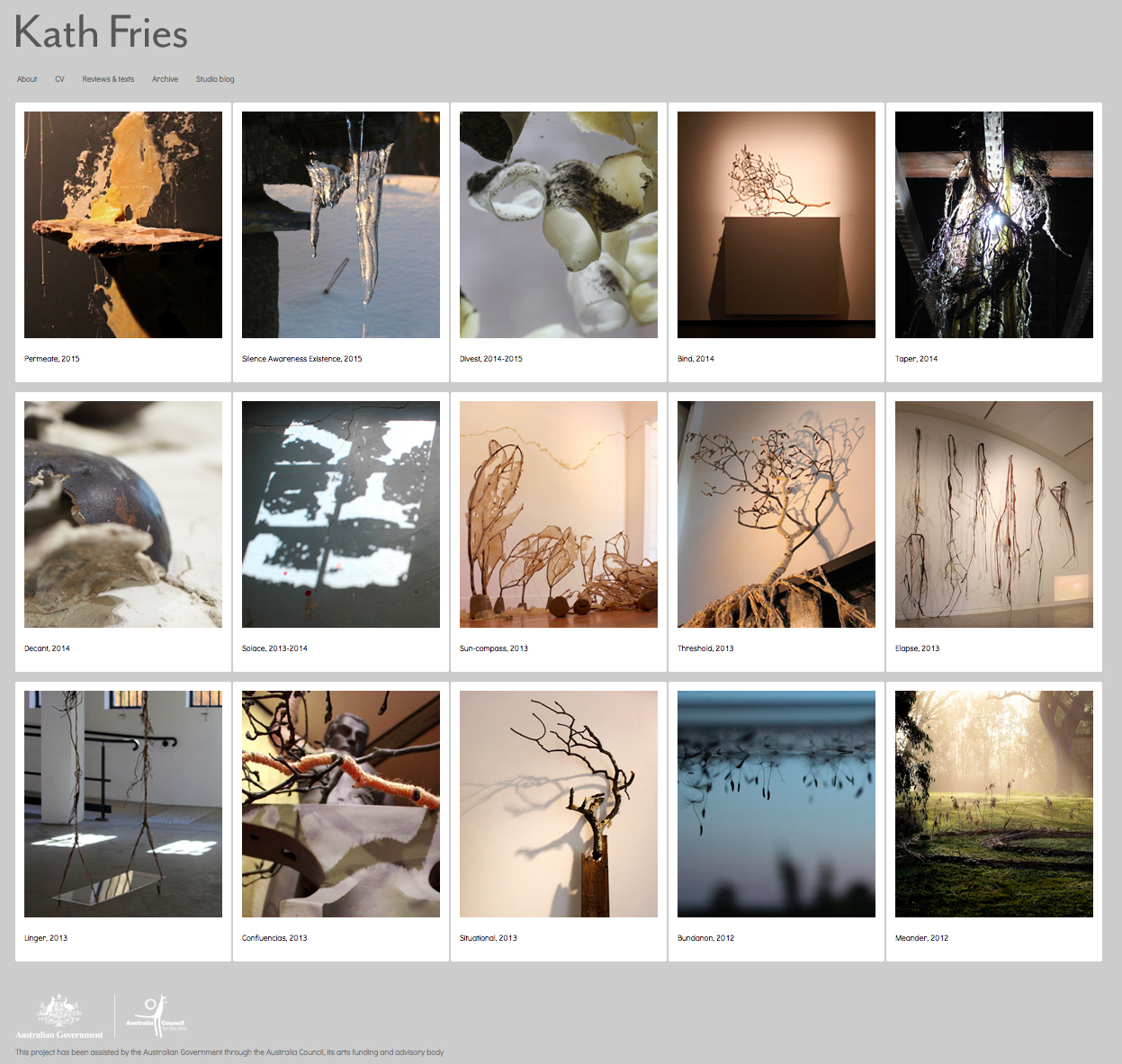
Kath Fries, Divest, 2016, beeswax and ash, 460x520x240cm
Casula Powerhouse Arts Centre, The 64th Blake Prize

Divest is an installation of beeswax and ash exploring the materiality of emotive states, poignant uncontainablity and the seeping intersections between the spiritual and physical, life and death, artifice and nature. Installed in a vertical crevice of the gallery, these beeswax polyp forms cluster together and gradually scatter out to seemingly invade the room, like barnacles or wasp nests creeping into human dominated spaces, unwelcome and uneasy. 'Divest' means to dispose - to deprive of rights or property. As the title of this work, Divest implies the loss of home and belonging, the emotional transient state of trying to attach and adapt to somewhere else. To be divested of home, family or identity is to seek refuge and sanctuary.

Kath Fries, Divest, 2016, beeswax and ash, detail view

This work is a cyclic embodied exploration of healing, fragility, abandonment, grieving and entropy. The beeswax funnels are brittle and empty, yet their fingerprinted surfaces evidence traces of warmth, movement and touch. Each form is scaled to encase a human finger, recalling how the beeswax was warmed and handled, moulded in healing and bandaging gestures, each piece was carefully wrapped around one of my fingers. These vestiges conjure ancient practices of using beeswax in healing and embalming processes, as a ritualistic material of both life and death.

Kath Fries, Divest, 2016, beeswax and ash, detail view

Beeswax also speaks of the hive; the bees’ honeycomb home, as a nurturing life force for the honeybees and focal point of their vital pollination roles in ecosystems. This implies an awareness of the current global honeybee crisis, emblematic of numerous growing environmental calamities threating the future of all forms of life on this planet. Extending this materiality metaphor Divest’s smattered ash echoes grieving rituals across many cultures, and on a personal level the act of scattering ash when installing the work, recalls my own father's cremation.

Kath Fries, Divest, 2016, beeswax and ash, detail view

The installation seemingly spills over a false wall and out of a corner of the gallery, conveying a sense that it cannot be contained, just as grieving and feelings of loss cannot be contained and can well up at any time. The repetitive contemplative process of individually creating each beeswax polyp form, conjures an embodied sense of present time that invites space for quiet reflection. As an installation, Divest invites the viewer into a similar state of private introspection.
More about my Divest series of installations - www.kathfries.com

Kath Fries, Divest, 2016, beeswax and ash, Casula Powerhouse Arts Centre

The exhibition is currently showing at Casula Powerhouse Arts Centre until 24 April 2016. www.casulapowerhouse.com


The 64th Blake Prize Finalists: Abdul-Rahman Abdullah, Frederico Ozanam Agostino Camara, Cigdem Aydemir, Vilma Barder, Teresa Baker, Julie Barthyolomew, Zanny Begg, Adnan Begic, Liam Benson, Drew Bickford, Tom Blake, Nicole Breedon, David Asher Brook, David Brophy, Michael Cardacino, Angela Casey, Omar Chowdhury, Valerio Ciccone, Roderick Collie, Simon Cooper, Dale Cox, Hilary Cuerden-Clifford, Darron Davies, Keg de Souza, Tamara Dean, Lada Dedic, Shoufay Derz, Dongwang Fan, Emma Fielden, Tina Fiveash, David Frank, Kath Fries, Robert Hague, Megan Hales, Corey Thomas & Roger Mitchell, Mehwish Iqbal, Matthew James, Shannon Johnson, Fassih Keiso, Madeleine Kelly, Yardena Kurulkar, Tom Lawford, Anita Larkin, Sonia Leber & David Chesworth, Tania Maria Mastroianni, Ian Mcleod, Matthew McVeigh, Reg Mombassa, Celia Morgan, Glenn Morgan, Bill Moseley & Joanna Logue, Nasim Nasr, Claudia Nicholson, Katy B Plummer, Chui Yee Po, Madeleine Preston, Marlaina Read, Mark Rodda, Margarita Sampson, Georgia Saxelby, Pamela See, Helen Shelley, Damien Shen, Sam Shmith, Sally Simpson, Sarah Spackman, Catriona Stanton & Anne Ooms, Michael Strum, Abdullah M I Syed, Jasmine Symons, Angela Tiatia, Annette Thas, Paul Trefry, Linda Wachtel, Brenda Walsh, Deborah White, Zan Wimberley, Katy Woodroffe and Vera Zulumovski.


Handheld melting - video and ice installation

Kath Fries, Handheld – melting, 2016, ice and video projection,
dimensions approximately 60x50x30cm

Handheld – melting is my current video and ice installation, which involves a daily assemblage of different melting ice pieces. This repetitive embodied process engages with touch, materiality, temperature and transience. As I handle and place the ice pieces, I feel them melting against my skin and the immediacy of this engagement is also apparent to the viewer as the shape, form and reflections of the ice changes as it melts. The video of dripping icicles was filmed exactly a year ago, in Finland's frozen landscape and snowy climate, which starkly contrasts the hot humid weather of February in Sydney. 

Kath Fries, Handheld – melting, 2016, ice and video projection, detail view
Kath Fries, Handheld – melting, 2016, ice and video projection
Kath Fries, Handheld – melting, 2016, ice and video projection, detail view
Kath Fries, Handheld – melting, 2016, ice and video projection

Kath Fries, Handheld – melting, 2016, ice and video projection, detail view

Handheld – melting is currently exhibited in Her Moving Presence at AirSpace Projects, 10 Junction St Marrickville NSW, until 20 February.
For more images of this work please see www.instagram.com/explore/tags/handheldmelting/

Her Moving Presence - group exhibition

Kath Fries, Handheld – melting, 2015-2016, ice and video projection, 24x12x36cm

Her Moving Presence is an exhibition of moving image work by twelve female artists, navigating both implied and actual presence through the mediums of video, projection, interactivity and screen based performance. The works presented are reflections of the body as presence, not solely the view of female presence in front of the camera, as the viewed being – but rather, female presence behind the camera, as the viewer/creator. Her Moving Presence explores the negotiation of the feminine self through time, space and objects. The reading of this visible and invisible presence allows the construct of an internal dialogue that affirms the understanding of our many selves. The self is determined internally: therefore the conclusion of feminine identity is never specific or absolute. These curatorial themes are echoed in the possibilities inherent in the moving image medium. A medium dependent on light and constantly in flux, it is itself defined by both the visible and invisible, and the passage of time. Mediating, and indeed defining, the notion of ‘self’ through screen based mediums is almost a ubiquitous part of being visible in the world of a technology driven society. This exhibition looks at the multifarious ways that this manifests from a feminine perspective – from the personal to the political, from gender to cultural issues, from trace to technology.

Kath Fries, Handheld – melting, 2015-2016, ice and video projection, detail view


My work in Her Moving Presence is a video of icicles projected through a melting frame of ice. This installation has developed from my residency in Finland last February, now exactly a year later, Sydney's hot humid summer February climate starkly contrasts the frozen mid-winter of February in Finland. When I arrived at my residency everything was blanketed in snow - a timeless magical winter wonderland. Yet the following week it all changed dramatically with the first early thaw of the season. Handheld – melting intimately recalls that day, how I held an icicle between my un-gloved thumb and index fingers, feeling it melt quickly within my grasp. Freezing water ran down my hand as my fingertips soon met in the middle and the icicle fell and shattered on the ground. Handheld – melting evokes that sensation of time slipping away and our inability to grasp transience. Emotionally and physically feeling entangled within existence’s continuous flux and flow, watching a lingering cluster of icicles drip innocuously from a drainpipe into the ground, catching the colours of the sunset. more info

Her Moving Presence
www.cargocollective.com/hermovingpresence

Her Moving Presence
5 February – 20 February 2016
AirSpace Projects
10 Junction St, Marrickville NSW 2204

Opening night: Friday 5 February 6-8pm
Gallery hours: Thursday to Saturday 11am-5pm
www.airspaceprojects.com

Artists: Ella Condon, Fiona Davies, Kath Fries, Sylvia Griffin, Yvette Hamilton, Melissa Howe, Danica Knezevic, Vivienne Linsley, Sarah Breen Lovett, Sara Morawetz, Katy Plummer, and Tamara Voninski. Curators: Yvette Hamilton and Danica Knezevic.

Laughing Waters Road - group exhibition

My first artist-in-residence experience was in 2009, at Laughing Waters in Eltham Victoria, along with composer Kate Moore. For four weeks we lived in the Birrarung mud-brick house and had a wonderfully productive time creating works responding to the natural sounds, sights and textures of the area. Nillumbik Shire Council has now been running the Laughing Waters artists-in-residence program for fifteen years, and I'm delighted to be included in this exhibition celebrating the residency's longevity, Laughing Waters Road: Art, Landscape and Memory in Eltham.

Kath Fries, Chasing Rainbows, 2009, photograph
cargocollective.com/kathfries/Chasing-Rainbows-2009

video link - vimeo.com/149921162

My work in the exhibition is Chasing Rainbows 2009, a playful ephemeral work created in the landscaped ponds next the the house. It rained heavily during our residency and these ponds were full to the brim. When the water stilled to a mirror-like reflective surface, I experimented with simple handheld kinetic interventions, gently rocking glass mirror panels in the water so they shimmered with afternoon sunlight that danced whimsical rainbows onto nearby rocks. This video documentation of replicating and directing capricious rainbows conjures the enchanting and temporal nature of my residency at Laughing Waters, being attentive and responsive to that particular time in a wonderful place. 

Laughing Waters Road exhibition invitation
Laughing Waters Road: Art, Landscape and Memory in Eltham
30 January - 14 March 2016
Montsalvat, 7 Hillcrest Ave, Eltham 3095

Artists: David Adams & Evi van der Niet, Penelope Aitken, Hannah Bertram, Craig Burgess & Kate Hill, Tim Burstall, Mirranda Burton, Carolyn Eskdale, Sue Ford, Kath Fries, Anna Glynn, Elizabeth Gower, Loren Grant, Melinda Harper, Eugene Howard, Anderson Hunt, Jessie Imam, Paul Kalemba, Ashlee Laing, Michael Mark, Scott Marr, Leanne Mooney, James Morrison, Joanne Mott, John R Neeson, John Nixon, Jill Orr, Michael Peck, Greg Pryor, Aviva Reed, Cameron Robbins, Melanie Scaife, Camille Serisier, Tetsutoshi Tabata & Mariana Verdaasdonk, Erin Tappe, Arlene Texta Queen, Liz Walker, Andre White and Susan Wirth.

Group exhibition: ART + NATURE + SCIENCE

Kath Fries, Sun-compass ii, 2015,
stringy bark, beeswax, thread and sunlight

ART+NATURE+SCIENCE is an exhibition of 35 artists who have participated in the Culture at Work art and science program over the past five years. 

Artists: Axel Singer, Alex Wight, Carrie Ramig, Fiona Davies, Fiona Kemp, Frances Hansen, Georgina Brinkman, Georgia Saxelby, Gilbert Grace, Jayanto Damanik, Josh Wodak, Julia Kennedy-Bell, Julie Brooke, Kath Fries, Laura Jade, Lisa Sammut, Lisa Roberts, Liz Shreeve, Luke Hespanhol, Melanie Eden, Melody Lord, Meta Cohen, Rachel Park, Sherryl Ryan, Soyoun Kim and Tom Hungerford. 

Culture at Work
6-8 Scott St, Prymont NSW
Opening Sat 28 Nov 3-6pm
continues to 6 Dec 2015, Thurs-Sun 11am-3pm

cultureatwork.com.au/artnaturescience-2010-2015

For ART+NATURE+SCIENCE, I've revisited an element of my 2013 Culture at Work Sun-compass project, which traced notions of honeybee flight, pollination and colony communication -link. Coated in beeswax, these curled lengths of stringy bark slowly twirl around their fragile axis, evoking cyclic notions of time. Beeswax is fragrant, malleable and fragile; its translucency and honey aromas are intensified by changes in natural sunlight and summer temperatures. The movement in Sun-compass ii conjures a honeybee waggle dance, communicating the direction and distance to pollinating flowers in relation to the movement of the sun and hive location.

Humans have been fascinated with bees and their honey since ancient times. With over 20,000 species of bees in the world, almost all human agricultural practices continue to involve keeping ‘domesticated’ bees. In ancient Greece Aristotle recorded his observations of honeybee behaviour, and Karl von Frisch is generally credited as being the first to decode the honeybee’s waggle dance. Today scientists are still learning more about honeybees’ complex behaviours, adaptations and the super-organism of the beehive. Honeybees are the second most researched species on the planet, after humans.

Over the past ten years, cycles of crisis have been intensifying amongst ‘domesticated’ western honeybees globally. Termed Colony Collapse Disorder (CCD) this manifests as disorientated honeybees fail to return to their hives, they get lost as their weak immune systems cause their internal ‘sun-compasses’ to fail. Scientists believe CCD is caused by a combination of factors including habit loss from land clearing, pesticide use, genetic reduction and industrialised agriculture. The loss of honeybee colonies is already stressing worldwide human food production, as we rely on honeybees to pollinate over a third of our global food crops.

My practice and research focus on relational embodied engagements with materiality and how these encounters can be synonymous with present time experience. Working with site-responsive processes and exploring sustainability, I seek ways to connect with place through the entanglement of our senses with our surroundings. I am intrigued by the complexity, diversity and symbiosis of the ecosystems in which we live, particularly aspects which are easily overlooked or dismissed, like the vital role that bees and other insects play in pollinating flowering plants, including eucalyptus trees. Quiet observation and attentiveness are important aspects of my process, gradually revealing poetic links between humans and nature, locality and history, micro and macro, existence and mortality.

Kath Fries, Sun-compass ii, 2015,
stringy bark, beeswax, thread and sunlight

Studio visits

Over the past couple of months I've had a few visitors to my studio at Sydney College of the Arts, thanks to friends, colleagues and the SCA grad-school students who run a curator visits and collective club. www.acuratorvisits.com 

Kath Fries, SCA studio, beeswax, branch and found materials, October 2015
Kath Fries, SCA studio, beeswax sheets stacked, September 2015
Kath Fries, SCA studio, beeswax and plant roots, October 2015
Kath Fries, SCA studio, beeswax and plant roots, November 2015
Kath Fries, SCA studio, beeswax and bark, November 2015
Kath Fries, SCA studio, beeswax wall, November 2015


Embodied attentiveness with bees(wax)

Last year I presented a paper at the SCA New Materialism in Contemporary Art Conference. The paper is now online - link 


You can find links to all the conference papers online and read an excerpt from my paper on the SCA New Materialism in Contemporary Art blog - link

Preview of Embodied attentiveness with bees(wax), SCA New Materialism in Contemporary Art
https://newmaterialismincontemporaryart.wordpress.com/2015/05/11/kath-fries-embodied-attentiveness-with-beeswax/

Reflecting on the growth of the John Fries Award

John Fries Award 2015 catalogue cover. Artwork: Will French, All, 2015
Read online catalogue - www.johnfriesaward.com

I've been involved in running the John Fries Award since it was established in 2009 as a memorial prize by the Viscopy board and the Fries family, to honour the formative influence John Fries had on the development of Viscopy. 

John had been a Viscopy Director and Honorary Treasurer for five years until his tragic and unexpected death in 2009. As an accountant with extensive experience in the corporate environment, John’s contributions to the organisation were anchored in his realistic and forward-thinking attitude. He possessed a true empathy with the financial challenges faced by artists. 


John was an adventurous and curious person, always keen to travel and explore opportunities. He followed current events and held strong views on social, political and economic issues. He was an avid reader, visited galleries and enjoyed attending theatre and music performances, but was often baffled by the more contemporary end of the cultural spectrum. I imagine he would find many of the artworks in the John Fries Award challenging, but I like to think he would take the time to consider their humour, personal as well as socio-political contexts, and how they comment on current events.

John Fries Award 2015 catalogue page 7 - Kath Fries
Read online catalogue - www.johnfriesaward.com

I am very fortunate to have had two parents who both supported me in becoming an artist, especially with a father as an accountant; he knew I was embarking on a career that was the antithesis of his, extremely financially unstable but richly rewarding in other areas. John’s motivation on the Viscopy board was largely due to me being an artist, and trying to understand and assist more broadly with the complex landscape of supporting culture in our society. Particularly in retirement, John was thoughtful and engaged in sharing and extending his financial skills by working pro-bono with the Red Cross and Rotary, as well as Viscopy. These positions were part of his personal contribution towards creating a more diverse and generous world. 

My father’s proactive attitude has influenced my work with Viscopy on the John Fries Award since its beginning. Over that time, the award outgrew the exhibition spaces in Viscopy’s Chippendale offices, into the eclectic Gaffa Galleries artist-run-space, and now it is presented in the impressive new galleries of UNSW Art & Design. The network of finalists and winners has become a remarkable list of alumni. Even within six years, several of our past winners and finalists have received significant grants, sales and commissions, as well as overseas exhibitions, opportunities and residencies. The guest curators, judges, Viscopy board and committed team at the Copyright Agency have all been essential to our work towards the goal of pursuing best practice in administering the award, valuing the work that artists do and the importance of the complex creative processes behind their artworks. 

Each year the John Fries Award presents an exciting and engaging exhibition, but beyond that, the award’s generous and inclusive sentiments ripple out into our larger cultural landscape. 

I’m proud of how the John Fries Award reflects and commemorates John’s pragmatic and benevolent support of his family, friends, colleagues and community, by seeking ways to assist them to develop their skills, explore opportunities and pursue their dreams. 

Kath Fries
Artist and daughter
September 2015

John Fries Award 2015 Public Programs 

The 2015 John Fries Award Finalists exhibition is currently showing at UNSW Galleries Paddington and continues to 10 October 2015
www.johnfriesaward.com
~

Ben Ward - 65 year old Miriwonng elder wins the 2015 John Fries Award for emerging artists

Congratulations to Ben Ward - winner of the 2015 John Fries Award, for his painting Our Country! Ben is a respected Miriwoong elder, from the East Kimberly WA. At 65, he's the oldest John Fries Award finalist and also the first winner from Western Australia. Ben has only been painting for four years, but has developed his own distinctive style of using brightly coloured tessellating triangles to depict his local Miriwoong country. 

Ben Ward, Our Country, 2015, natural ochre on plywood, 122x240cm
Winner of the 2015 John Fries Award


Ben’s paintings tell of the landscape, stories and sacred sites flooded by the Lake Argyle Dam, Western Australia’s largest artificial lake, which was constructed near Kununurra in the east Kimberley in the early 1970s. video interview

Ben says, “I began painting to share my cultural knowledge with others. Art gives me an opportunity to express myself and tell the traditional Miriwoong stories. If you can’t get any messages out to the younger generations in the world about what this area is about, it’s good to put it in a painting … all that’s underwater now, and that’s what I paint. Everything that’s underwater, I remember every bit of it.” more about Ben Ward

New Zealand artist Kenneth Merrick was highly commended for his work Foible. more about Kenneth Merrick

Many thanks to the judges, guest curator, JFA team, Viscopy board and Copyright Agency, my family, UNSW Galleries, our sponsors, the fabulous 15 finalists and all the 730 artists who entered this year!

The 2015 John Fries Award Finalists exhibition is on at UNSW Galleries Paddington until 10 October. 

www.johnfriesaward.com

'A Jester's Whisper' 2015 John Fries Award exhibition catalogue - download

Invitation - John Fries Award Finalists Exhibition

As the Chair of the John Fries Award, I'm delighted to invite you to the 2015 John Fries Award Finalists Exhibition. 
Opening 5pm Friday 4th September, continuing to 10th October 2015, UNSW Galleries, cnr Oxford St and Greens Rd, Paddington NSW.

The 2015 finalists are: Erin Coates (WA), Georgie Roxby Smith (Vic), Eloise Kirk (Tas), Kenneth Merrick (NZ), Kelly Doley (NSW), Archie Moore (Qld), Tim Bruniges (NSW), Tully Arnot (NSW), Darcell Apelu (NZ), Ben Ward (WA), Giselle Stanborough (NSW), Leo Coyte (NSW), Will French (NSW), Vincent Namatjira (SA) and Biljana Jancic (NSW).

John Fries Award 2015 Finalists Exhibition invitation

The 2015 John Fries Award is curated by Oliver Watts, and judged by Justin Paton (curator AGNSW), Nell (artist), Kath Fries (artist), Oliver Watts (guest curator).

The John Fries Award is an annual non-acquisitive award of $10,000 recognising emerging and early career visual artists. Since its start in 2010, it has become a platform for some of the most engaging and experimental works from emerging artists across Australia and New Zealand. The award was established by the Fries family and the Viscopy board, in memory of former Viscopy director and honorary treasurer, John Fries, who made a remarkable contribution to the life and success of the organisation. 
www.johnfriesaward.com


John Fries 1943 - 2009
viscopy.net.au/john-fries-award/john-fries-bio