Strain, site-specific installations in Primrose Park


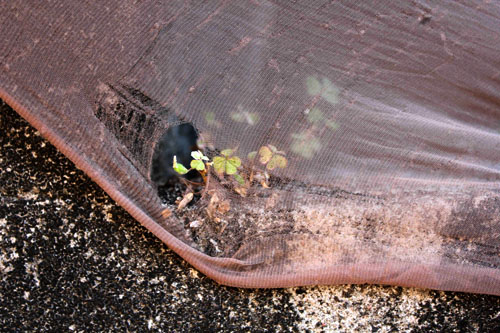
Kath Fries, Strain, 2011, nylon pantyhose and heritage site,
installation work in progress November
The Aqua-librium exhibition, 9 - 18 December 2011, will feature works from my Strain project, developed over the last five months whilst a studio artist at Primrose Park.

Kath Fries, Strain, 2011, nylon  pantyhose and heritage site,
installation work in progress October
My installations take the form of interventions and site-specific responsive works located on and in the park's aging concrete industrial structures; heritage listed sewage works' former engine house, aqueducts, tunnels and canals.

Kath Fries, Strain, 2011, nylon pantyhose and heritage site,
installation work in progress November

Ferns, weeds and mosses have been collected and transplanted short distances within Primrose Park then carefully combined with domestic gardening materials to form micro futuristic landscapes. Some hang suspended from the ancient rusted hooks of the sewage works’ structures, whilst others follow undulations under the aqueduct arches. I have also worked with weeds growing naturally in crumbling fault-line cracks in the concrete walls.

Kath Fries, Strain, 2011, nylon pantyhose, water-saving-crystals and weeds
installation work in progress October

Stain reflection on human relationships with nature, focusing on the past and present attempts to control the flow of water in Primrose Park. The site was originally a food bowl for the Cammeraygal people, a fertile estuary bay where a number of streams converged to enter the harbour.

Kath Fries, Strain, 2011, nylon pantyhose and heritage site,
installation work in progress November
In 1891 the tidal marshland was filled in and ‘reclaimed’ to house North Sydney’s first sewage treatment works. Water was an intrinsic part of these early waste management strategies so natural streams were redirected through the concrete aqueducts, canals and industrial structures. A generation later the area was converted into a sports-ground and still today, during heavy rainfall, masses of storm-water flushes through the site and weeds run rampant.

Kath Fries, Strain, 2011, nylon pantyhose and heritage site,
installation work in progress November
Strain explores what we value about water and plants, contrasting what we waste and consider to be waste. Water is highly valued when it in short supply, but when there is too much we can’t get rid of it fast enough. The movement of water is both a creative and destructive force, eroding and forcing its way through concrete surfaces, spreading fertile topsoil and weeds.

Kath Fries, Strain, 2011, nylon pantyhose, water-saving-crystals and weeds,
installation work in progress November
Most weeds were originally introduced to fill out decorative domestic gardens, but when they have escaped the picket fence, our view of them changes from 'plant' to 'pest'. However, there is something about the tenacious character of these fugitive plants that appeals to me. Primrose Park has an abundant supply of weeds, thanks to the inexorable natural flow of water from the elevated suburbs down into the harbour below and the fertile soil redolent of the sewage works. My locally relocated weeds are playfully combined with the domestic gardening practice of using stockings and pantyhose to direct the growth of plants, gently binding seedlings to stakes as they grow.

Kath Fries, Strain, 2011, nylon pantyhose and heritage site,
installation work in progress October
This material is closely associated with human skin, as pantyhose are usually worn against the skin clinging to the bumps and lumps of our legs, thighs and bottoms.  Like our skin,   pantyhose sheer nylon ages and tears, wrinkling and sagging as it loses its elasticity.


Kath Fries, Strain, 2011, nylon pantyhose and heritage site
installation work in progress October
The staging of pantyhose as artwork in this public place is akin to publicly airing dirty underwear, almost a violation of social norms verging on infringement of taboos. My use of this material within the historic sewage works, metaphorically comments on our avoidance of discussing the specific environmental impact of our ever increasing human natural waste – sewage.

Kath Fries, Strain, 2011, nylon pantyhose and heritage site,
installation work in progress October

Historical photographs of Primrose Park Cremorne

Primrose Park Engine House, circa 1900
I've been researching former uses of the Primrose Park area, where I'm currently one of two artists sharing the studio space for six months. Interestingly, our studio is located in the basement of the former sewage works engine house.
The history of the area and remaining industrial concrete structures are pivotal to my current site-responsive works. These works will be exhibited as part of Aqua-librium 9 - 18 December 2011 at Primrose Park Gallery, Young Street, Cremorne.

Primrose Park, circa 1901
Primrose Park septic tanks, circa 1905
Primrose Park in 1918
Primrose Park, waterfall, circa 1878
Primrose Park outfall works, circa 1910
Primrose Park, circa 1937
To see more historical photographs of the Primrose Park area go to the online North Sydney Council Stanton Image Library 

Quagmire - documentation of site-specific works in progress at Primrose Park Cremorne

Kath Fries, Quagmire, 2011, work in progress August
I've been sharing the studio space at Primrose Park Cremorne over the last few months and observing the changing climate and weather conditions.
Kath Fries, Quagmire, 2011, work in progress August
My first series of site-responsive installations and interventions focused on the weeds growing the cracks of the aging concrete edifices of the site. Using 'water saving crystals' (a domestic gardening substance that you can buy in most hardware stores and nurseries) and tiny mosses, ferns and weeds collected around the site. 
Kath Fries, Quagmire, 2011, work in progress September
These materials are carefully constructed into micro futuristic landscapes - like tiny zen gardens, following the cracks and undulations of the concrete horizontal surfaces of the aqueduct arches of Primrose Park. 
Kath Fries, Quagmire, 2011, work in progress September
Weeds naturally grow in crumbling and fault-line cracks in the concrete, as water naturally permeates and seeps from higher ground towards the ocean. The water-saving-crystals respond and change as the amount of water in the concrete and atmosphere ebbs and changes. 
Kath Fries, Quagmire, 2011, work in progress September
I tentatively titled these initial works Quagmire. I like the dual meaning of the word: - a soft marshy area of land that gives way when walked on; and an awkward, complicated, or dangerous situation from which it is difficult to escape. Both meanings of the title Quagmire add layers of meaning to the installations. 
Kath Fries, Quagmire, 2011, work in progress September
The Primrose Park area was originally a marshy, mangrove estuary bay where a number of streams converged to enter the harbour. Despite human efforts to change this marshy area by "reclaiming" it from its natural state (becoming North Sydney's first sewage works in 1981, then in the 1920's when urbanisation outgrew those facilities the area was turned into sports-grounds) storm-water naturally continues to run along the same old routes down to sea level. Heavy rainfall causes the 1890s concrete spillways to gush with storm-water overflow. Even in dry weather small pockets of marshy bog remain.
Kath Fries, Quagmire, 2011, work in progress September

Strand, installed at Gallery Eight, Millers Point

Kath Fries, Strand, 2011, nylon (synthetic hair extensions), electrical cord, light bulb,
detail view, part of 
Affinity group exhibition, Gallery Eight, Millers Point Sydney


Strand explores connections between memory and the body, by manipulating the viewer’s visceral reactions to a common everyday substance - hair. A person's hair can provoke polarized responses, in some circumstances it is a beautifying adornment, signalling seduction. But when discarded, hair strands become a revolting abject substance, tangled in a bathroom drain. In Strand, nylon (synthetic hair extensions) bind an electrical current, forming a poetic metaphor about intimate connections between people. Like a lover's lock of hair traditionally kept as a memento and the sense of intimacy evoked when finding another person's strand of hair on one's skin or clothing. 
The transience of existence and fragility of life are recurring themes throughout my art practice. My work explores materiality, spatiality and archetypical narratives by marking a personal, immediate engagement with time, place and physicality. I use domestic materials and natural elements to create site-sensitive installations linking one’s present experience to boarder considerations of humanity, history and future continuation.

Kath Fries, Strand, 2011, nylon (synthetic hair extensions), electrical cord, light bulb,
installed at Gallery Eight, Millers Point Sydney, as part of Affinity group exhibition

Strand is currently being shown as part of Affinity group exhibition at Gallery Eight. Affinity explores intimacy in all its forms and incarnations involving relationships with the self, the other, places or objects, the physical and the emotional. Artists have called into question the notion of closeness through a wide range of practices and mediums. Loneliness, sexuality, the home, touch and emotional vulnerability are all themes explored by the artists involved. 

Artists: Amanda Humphries, Amy Gardner, Becky Gibson, Celine Roberts, Danielle Tam, Isabella Andronos, Jessica Tse, Kath Fries, Mandy Schöne-Salter, Maz Dixon, Yvette Marie Tzalias

28 October - 17 November, 2011
Gallery Eight, 12 Argyle Place, Millers Point, Sydney NSW 2000


Kath Fries, Strand, 2011, nylon (synthetic hair extensions), electrical cord and light bulb,
detail view, part of
Affinity group exhibition at Gallery Eight, Millers Point Sydney

Tokyo - hanging gardens

Kath Fries, Tokyo hanging garden, 2011, photograph
My research in Japan was made possible by the Japan Foundation and ArtStart grant program

Aso - views

Kath Fries, Aso view i, 2011, photograph
Kath Fries, Aso view ii, 2011, photograph
Kath Fries, Aso view iii, 2011, photograph
Kath Fries, Aso view iv, 2011, photograph
My research in Japan was made possible by the Japan Foundation and ArtStart grant program.

Aso - water

Kath Fries, Aso spring, 2011, photograph


From the crater of an ancient volcano
the most delicious water
springs from under the ground
bubbling to the surface
sustaining beautiful natural landscapes 
healthy agriculture and happy locals.
People travel for miles 
to slack their thirst 
at these traditional sources
of healing and cleansing.


Kath Fries, Aso water i, 2011, photograph

Kath Fries, Aso water ii, 2011, photograph
My research in Japan was made possible by the Japan Foundation and ArtStart grant program.

Teshima - art island

Kath Fries, Teshima curl, 2011, photographer


Kath Fries, Teshima fence, 2011, photographer

Kath Fries, Teshima Art Museum cafe, 2011, photograph

Kath Fries, Teshima net, 2011, photograph


My research in Japan was made possible by the Japan Foundation and ArtStart grant program.

Naoshima - unravelling tree


Kath Fries, Naoshima unravelling tree i, 2011, photograph

Kath Fries, Naoshima unravelling tree ii, 2011, photograph
My research in Japan was made possible by the Japan Foundation and the ArtStart grant program.

Naroshima - architecture details

Kath Fries, Naroshima - architecture details ii, 2011, photograph
On Naroshima art island
Tadao Ando's fabulous architecture
was breath-taking
and the contemporary artworks were astounding

But it was the small details of nature 
against vast minimalist concrete surfaces 
that drew my lens

Kath Fries, Naroshima - architecture details i, 2011, photograph
My research in Japan was made possible by the Japan Foundation and ArtStart grant program.

Kyoto - rope and wood

Kath Fries, Kyoto rope and wood i, 2011, photograph
Kath Fries, Kyoto rope and wood ii, 2011, photograph
Kath Fries, Kyoto rope and wood iii, 2011, photograph
Kath Fries, Kyoto rope and wood iv, 2011, photograph
Kath Fries, Kyoto rope and wood v, 2011, photograph
Kath Fries, Kyoto rope and wood vi, 2011, photograph
Kath Fries, Kyoto rope and wood vii, 2011, photograph
Kath Fries, Kyoto rope and wood viii, 2011, photograph
My research in Japan was made possible by the Japan Foundation and ArtStart grant program.