Fremantle Arts Centre WA artist-in-residence

I'm currently artist-in-residence at Fremantle Art Centre WA. It's an interesting place with its beautiful old buildings, sunsets over the ocean and vibrant cultural scene. Located on the southern side of the city of Perth at the mouth of the Swan River, the traditional owners of this area are the Whadjuk Noongar people. An important colonial port and convict settlement, Fremantle is renowned for its well-preserved architectural heritage. The two buildings I'm working in both date back to colonial times, the artist-in-residence apartment is in the Moores Building - a converted old storehouse near the port, and up the road I have a studio in Fremantle Arts Centre, which was originally the local lunatic asylum. 


Fremantle Arts Centre AIR Studio - beeswax and old fashioned boiler

I've sourced some local beeswax for my residency project. Western Australia claims to produce some of the purest honey in the world, being so remote has some benefits - the honeybees here suffer from fewer of the pests and diseases that plague other parts of Australia and the rest of the world. 


 Fremantle Arts Centre AIR studio
These three windows of my studio face west and catch the afternoon sunlight

Like most of the old buildings here, Fremantle Arts Centre (FAC) was built from local stone with convict labour. Today FAC is vibrant with music concerts, performances, exhibitions and artists studios; but its history of convict labour, insanity and poverty lingers in the building's shadows with textured layers of spooky intrigue. My usual studio in Sydney at Sydney College of the Arts is a former psychiatric hospital, so it has a lot in common with FAC, and this place seems like an ideal site to continue working on my Divest installation project. 

Day one ofFAC Divest installation, work in progress - beeswax on window

Day two of FAC Divest installation, work in progress - beeswax on window

Day three of FAC Divest installation, work in progress - beeswax on window and floor


In my FAC studio space there are three windows that face west and catch the afternoon sunlight. A number of my beeswax installations over the past year have been situated on windows with direct sunlight coming through them. I'm drawn to watching sunlight permeate interior spaces, and how the shadows' progression across the room tracks the passage of time and the uniqueness of that particular day.

Day three of FAC Divest installation, work in progress - beeswax on floor

Day three of FAC Divest installation, work in progress - beeswax on floor

Day three of FAC Divest installation, work in progress - beeswax on floor

The beeswax funnels in Divest are made by wrapping warm pieces of beeswax around my fingers in a healing bandaging gesture. Then one edge is stretched, torn and thinned out into a marbled, fingerprinted, membrane like transparency. Natural light from the window illuminates the brittle edges of the clustered barnacle like funnels. Positioned in the corners and crevices of the studio space, they imply the porousness of our artificial boundaries, as though a colony of insects or crustaceans have invaded and inhabited this interior human space, then absconded and left their shell-funnel homes empty and abandoned. 

Day three of FAC Divest installation, work in progress

Day four of FAC Divest installation, work in progress, beeswax on window

Day four of FAC Divest installation, work in progress, beeswax on window

Day four of FAC Divest installation, work in progress, beeswax on window

Day five of FAC Divest installation, work in progress, beeswax on window


Divest is a process based project that considers cycles of healing, renewal, fragility, abandonment and entropy. The actual making and placing of the warm beeswax funnels is the pivotal stage of the work, so the resulting installation becomes just a trace of the process. The funnels are empty, although they look as though they may have contained insects or small sea creatures, what they actually held were human fingers. This embodied imprint links to ancient practices of using beeswax in healing and embalming processes, and questions the separation we often feel from nature in our contemporary lives today.  

Day five of FAC Divest installation, work in progress, beeswax on window

Day five of FAC Divest installation, work in progress, shadows on wall

Decant installation at Fairfield Museum

Last year I was artist in residence at Fairfield Museum and my resulting project, Decent, is now on display in the museum until 15 November 2014. Decant explores the passage of time and containment of memory, poetically reflected in the residue and trace of pouring water. Responding to two museum objects originally found on the banks of nearby Prospect Creek, Decant was a process based project, where the museum objects where cast and recreated into a series of replicas and delicate shards - intentionally dissected, semi-dissolved, broken and unstable. To read more about Decant, please see kathfries.com

Kath Fries, Decant, 2014, unfired earthenware paper clay and ink in museum display case

Kath Fries, Decant, 2014, unfired earthenware paper clay and ink in museum display case,  
installation dimensions 200 x 800 x 60 cm

Kath Fries, Decant, 2014, unfired earthenware paper clay and ink in museum display case

Kath Fries, Decant, 2014, unfired earthenware paper clay and ink in museum display case

Kath Fries, Decant, 2014, unfired earthenware paper clay and ink in museum display case

Kath Fries, Decant, 2014, unfired earthenware paper clay and ink in museum display case

Kath Fries, Decant, 2014, unfired earthenware paper clay and ink in museum display case

Kath Fries, Decant, 2014, unfired earthenware paper clay and ink in museum display case


Decent is on display at Fairfield Museum until 15 November 2014

Divest installation - New Materialism exhibition


Kath Fries, Divest, 2014, beeswax and ash installation, detail view

Divest is an installation of beewax and ash, which I created for the New Materialism PhD exhibition at Sydney College of the Arts Galleries, Rozelle NSW. This work is being exhibited in accompaniment to the SCA Grad School Conference, Tuesday 9 September 2014, where I presented my paper Beeswax – an ancient material in contemporary art


Kath Fries, Divest, 2014, beeswax and ash installation


New Materialism is an emerging trend in 21st century thought in several fields of inquiry, including philosophy, cultural theory, feminism, science studies, and the visual arts. Defined around the primacy of matter and its properties and actions, the New Materialism re-works long-held assumptions about the nature of the stuff of the universe. It responds to the need for novel accounts of agency, nature and social relationships in the contemporary epoch, when new questions have arisen about our place as embodied humans in the world and the ways we produce, reproduce and consume our material environment. In this challenge to invent new ways to understand the contemporary world, the visual arts have a special place given their concern with the manipulation of matter. For the artist or craftsperson in the studio or workshop, New Materialism can articulate and give agency to existing creative processes, and offer opportunities for new modes of authorship and expanded interpretations of materials and objects and our relationships with them.

Kath Fries, Divest, 2014, beeswax and ash installation

My interest in New Materialism relates to its consideration of non-human creatures, and all matter, as existing in an interconnected and constantly fluid state of flux, flow and change. This challenges conventional western notions of nature as a separate series of inert stable entities to be exploited by superior humans. The New Materialism discourse sees one of its tasks as creating new concepts and images of nature that affirm matter’s immanent vitality.


Kath Fries, Divest, 2014, beeswax and ash installation

This call to rethink how we use and abuse our natural environment, to shift our human-centric focus to consider that non-human things exist for their own ends and have not evolved for human use, is conveyed in the New Materialism re-purposing of the word ‘materiality’ to mean a ‘process’ rather than a ‘thing’.*

Kath Fries, Divest, 2014, beeswax and ash installation

Working with a ‘process’ of materiality, which is impermanent and unstable rather than a static series of separate things, is a notion that resonates in my practice. For me, this process is about reconciling myself with my surroundings and the world’s inescapable natural cycles of life and death, destruction and renewal. Since of the death of my father in 2009, most of my work has in some way related to grieving and reflecting on death as a natural unavoidable part of life. In turn, my aim to cultivate an awareness of the vitality of everyday existence reflects a number of ecological issues and concern for the way that we all often feel inherently separated from nature. I respond to this by working with a contemplative process that focuses on embodying sensory experiences of my surroundings, particularly the fragility and flux of time and materiality.

Kath Fries, Divest, 2014, beeswax and ash installation

Divest consists of small empty beeswax funnels clustered across the wall and smattered with ash, suggesting abandoned containers of life, hollow shells soon to disintegrate. Made by wrapping warm pieces of beeswax around my fingers in a healing bandaging gesture, the funnels are then pressed into the wall in barnacle like clusters, clinging together at various angles. Impressions of my fingers remain on the wax surfaces, even as they become cold and brittle.

Kath Fries, Divest, 2014, beeswax and ash installation, detail view

Embedded in the work is the symbolism of the materials themselves, the beeswax speaks of the hive, the bees’ honeycomb home, as a nurturing life force for the bees and their vital role in ecosystems. The ash is a symbol of grieving, ritual and cremation.


Kath Fries, Divest, 2014, beeswax and ash installation

The ways the honeybees build and adjust their wax-comb designs responses directly to the colony's' changing needs, and is integral to the communication and successful functioning of the super organism that is the beehive. All elements of the hive – worker bees, forager bees, queen bee, larvae, baby bees, drones, wax comb, temperature, form and space, nectar, honey and pollen – are interconnected and interdependent. The complex ecology of the world can be likened to the super organism of a beehive, where humanity is like a few foraging honeybees that cannot survive alone, separated from nature, outside the hive.


Kath Fries, Divest, 2014, beeswax and ash installation

My interest in the ways that we can understand an embodied engagement with time, materiality and nature, through the sensory experience of art, reflects New Materialism’s vitality. This takes a positive approach to the potential for change in human attitudes, proposing that we have the intelligence and creativity to re-engage with nature, and the complex interconnections of our world.


* Maurizia Boscagli, Stuff Theory: Everyday Objects, Radical Materialism (London: Bloomsbury Publishing, 2014). P 13


Kath Fries, Divest, 2014, beeswax and ash installation

 For more information on the 2014 SCA Graduate School Conference & Exhibition New Materialism see  sydney.edu.au/sca/research/new-materialisms 
The exhibition continues to 27 September 2014, open Monday to Saturday 11am - 5pm


Divest, beeswax installation - work in progress

Kath Fries, Divest, 2014, beeswax and ash on wall

Divest traces embodied experiences of impermanence and instability through the tactile material qualities of beeswax and ash. Reflecting on the passage of time and fragility of life, these barnacle-like beeswax forms suggest notions of sanctuary, healing and containment, while the smattered layers of ash conjure feelings of unease and vulnerability.

Kath Fries, Divest, 2014, beeswax and ash on wall, SCA studio
Kath Fries, Divest, 2014, beeswax and ash on wall
Kath Fries, Divest, 2014, beeswax and ash on wall, SCA studio
Kath Fries, Divest, 2014, beeswax and ash on wall, SCA studio 

Divest will be installed in the SCA Gallery for the New Materialism exhibition, 9 - 26 September 2014.
Sydney College of the Arts, Park Drive, Lilyfield NSW (enter opposite Cecily Street) sca.galleries@sydney.edu.au

New Materialism exhibition invitation, SCA Gallery
Kath Fries, Divest, 2014, beeswax and ash on wall
Kath Fries, Divest, 2014, beeswax and ash on wall, SCA studio

Taper - installation for BUNKERED

Kath Fries, Taper, 2014, beeswax, twine, tree roots and light bulb

Bunkered “… responds to the dystopic landscape of a climate-changed future within the context of a domestic dwelling. The term bunker can mean a fortification, a shelter, a storage area for provisions, and a difficult situation. While encompassing all of these layered meanings, to be ‘bunkered’ also suggests a reaction to external forces that are threatening and are ultimately unpredictable. In Bunkered, a dynamic of dialectic oppositions is set: fortifications can fail, shelters can be permeated, stored items can be lost and difficult situations can be mitigated. Containing all of these oppositions is the encompassing figure looming large in the exhibition – that of the house. Suggesting comfort, warmth, protection and security, the domestic context is placed at the forefront of the Bunkered concept. The artists explore how the notion of a home could change when its surrounding environment is toxic.
In this way Bunkered forges a corporeal relationship with the notion of home in a climate-changed world. In mapping this future on a house, we also map these results on ourselves.
… The sense of danger reaches a heightened state in Kath Fries’s attic installation, Taper. The attic, according to Bachelard is a space where “fears are easily ‘rationalised’…”, however here Fries inverts this place to one where fears are realised. Resembling a malevolent parasitic plant, Taper’s root-like tentacles permeate the roof and remind us that this shelter will soon be reclaimed to the new natural forms that have adapted to the altered climate. 
… We are invited to speculate on a future way of life in an entirely familiar way - through the living room, kitchen, bathroom and bedroom. By placing the concept within a lived environment, we experience the potentials of climate change not in the arms length relationship of a gallery setting, but rather up close, personal, with all of the sights, sounds and smells of a domestic context… Bunkered gives us the space to ask how we will relate to our notion of home when we are confronted with the psychological and emotional ramifications of life in a toxic climate, and ultimately questions, how will we live?"

Yvette Hamilton 
The House, the World

Kath Fries, Taper, 2014, beeswax, twine, rope, tree roots and light bulb

BUNKERED ARTISTS: Aaron Anderson, Lisa Andrew, Sarah Breen Lovett, Kuba Dorabialski, Kath Fries, Yvette Hamilton, Anna Horne, Rachael McCallum, Sarah Nolan, Office Feuerman, Katy B Plummer, Madeleine Preston, Marlene Sarroff and Lotte Schwerdtfeger.

BUNKERED
6 - 27 September 2014
Open: Thursday to Saturday 2-5pm
26 Ross Street, Forest Lodge, NSW 2037
www.branch3d.com.au

Opening Event: Saturday 6 September, 4-7pm (tickets)
Artcycle tours: every Saturday
Artist talks: Saturday 20 September, 2.30pm

BUNKERED is curated by Sarah Nolan, with an exhibition essay by Yvette Hamilton, and presented by BRANCH3D Gallery as part of Sydney Fringe Festival 2014

Taper - work in progress for BUNKERED exhibition

Kath Fries, Taper - work in progress, 2014, beeswax, twine, tree roots and light bulb

BUNKERED is a group exhibition situated in an inner city terrace, which contemplates life in a climate-changed future. Fourteen artists are creating works that challenge traditional relationships to domestic spaces.

Kath Fries, Taper - work in progress, 2014, beeswax, twine, tree roots and light bulb


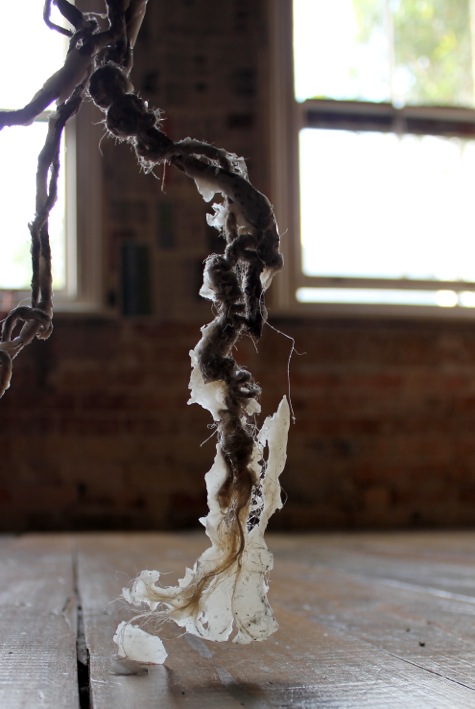
Located in the BUNKERED attic, my installation Taper features entwined roots that dangle dripping with congealed beeswax. They stretch down from the pitched darkness, through the ceiling beams, towards a solitary dim light bulb. The roots are dead, dried and fragile, trickled with beeswax and wrapped in twine, some are almost fossilised into stalactites.

An attic purports to be safe haven, the room furthest from the street and closest to the sky, an enticing quiet place for humans, flora and fauna seeking refuge from the outside world. But a garret is also traditionally a place of poverty and madness, where creatures and people eventually meet their demise.

To taper is to gradually grow narrow towards one end, to taper off; and a taper is a thin candle. Located in an internal space that narrows into a pitched roof, where wax stalactites and plant roots hang like upturned candles thinning to a dripped point, Taper implies that escape is impossible. Uncontainable toxins and pollutions leach through the earth and air, seeping into our interior spaces to potentially poison all aspects of our lives.

Kath Fries, Taper - work in progress, 2014,
beeswax, twine, tree roots and light bulb

BUNKERED ARTISTS: Aaron Anderson, Lisa Andrew, Sarah Breen Lovett, Kuba Dorabialski, Kath Fries, Yvette Hamilton, Anna Horne, Rachael McCallum, Sarah Nolan, Office Feuerman, Katy B Plummer, Madeleine Preston, Marlene Sarroff and Lotte Schwerdtfeger.

BUNKERED
6 - 27 September 2014
Open: Thursday to Saturday 2-5pm
26 Ross Street, Forest Lodge, NSW 2037
www.branch3d.com.au

Opening Event: Saturday 6 September, 4-7pm (tickets)
Artcycle tours: every Saturday
Artist talks: Saturday 20 September, 2.30pm

BUNKERED is curated by Sarah Nolan, with an exhibition essay by Yvette Hamilton, and presented by BRANCH3D Gallery as part of Sydney Fringe Festival 2014

Download the Bunkered catalogue

The opening afternoon, Saturday 6 September, 4-7pm, is a free registered ticketed event. Tickets are available through Eventbrite. There will be six half hour timeslots scheduled for groups of up to 18 people visiting at a time. The meeting point is Forest Lodge Hotel, 117 Arundel Street, where BUNKERED volunteers will give you a designated time to visit the exhibition. All other opening times will not require a ticket, Thursday to Saturday 2-5pm until 27 September.

Bunkered exhibition invitation

2014 John Fries Award opening invitation

It's my pleasure to invite you to the opening of the 2014 John Fries Award finalists exhibition: 6pm, Tuesday 12th August, UNSW Galleries, cnr Oxford St & Greens Rd, Paddington, NSW. 


The 2014 John Fries Award finalists are: Abdul Abdullah, Justin Balmain, Ella Barclay, Tim Bruniges, Julian Day, Omar Chowdhury, George Egerton-Warburton, Marc Etherington, Hamishi Farah, Heath Franco, Samuel Hodge, Anna Horne, Juz Kitson, Anna Kristensen, Bridie Lunney, Daniel McKewen, Beryline Mung, Ramesh Mario Nithiyendran, Alair Pambegan, Kate Scardifield, Marilyn Schneider, Jacqui Shelton, Jason Wing and Kentaro Yamada.
To preview their work go to www.viscopy.org.au/jfa