Pause sculpture @ SCAP 3D finalists exhibition

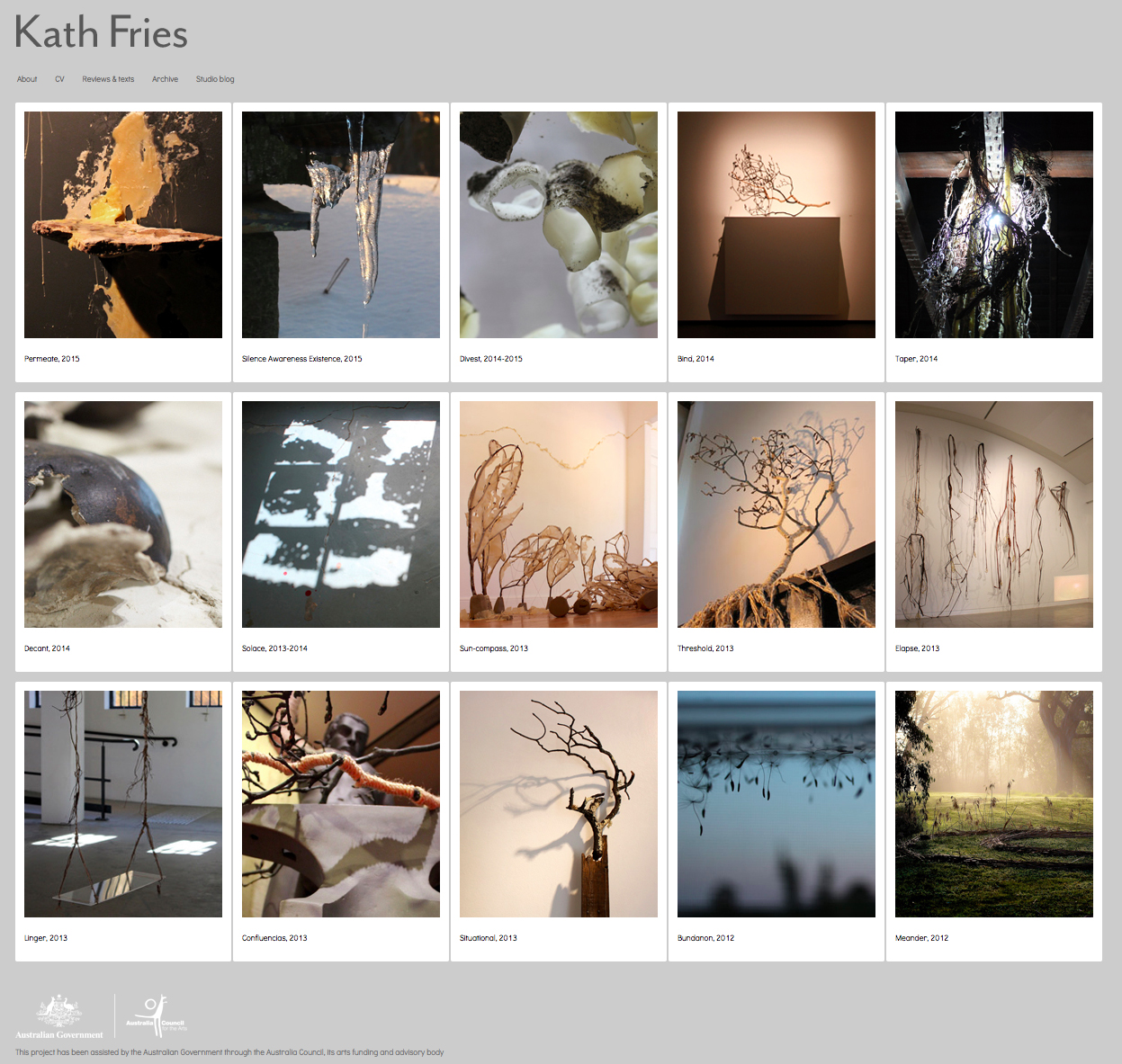
Kath Fries, Pause, 2013, in the SCAP 3D online catalogue
www.3d.scap.org.au/finalist/kathfries-pause
 

I'm delighted to have my work, Pause (2013), selected and exhibited in this year's Sunshine Coast 3D Art Prize finalists exhibition. This is the second year that my work has been selected for SCAP3D - an annual exhibition and prize showcasing an interesting range of contemporary sculptural work from around Australia. 

SCAP 3D finalists include Sally Adair, Carolyn Barker, Catrine Berlatier, Emily Valentine Bullock, Matt Calvert, Jason Christopher, Erin Conron, Clinton Cunningham, The Winged Collective Falcini & Gottgens, Timothy Fleming, Mandy Gunn, Christopher Handran, Lyndal Hargrave, Fiona Hiscock, Chris Howlett, Lea Kannar, Michaela Kloeckner, Dinni Kunoth Kemarre, Francesca Mataraga, Carol McGregor, Nadia Mercuri, Natasha Natale, Derek Thompson and Ngunytjima Carroll, Ann O’Connor, Lae Oldmeadow, Sarah O’Sullivan, Tracey Sarsfield, Caroline Watson, Jacek Wankowski, Di West, Lisa Brummel, Johanna DeMaine, Rowley Drysdale, Hew Chee Fong, Nicole Hoschke, Ann Hounslow, Marc Kalifa, Wayne Markwort and Vit Martinek.

Sunshine Coast 3D Art Prize
29 August – 20 October 2013
Noosa Regional Gallery, Pelican St, Tewantin QLD 

Farewelling Hill End and Murray's cottage


Kath Fries, Mistletoe in the afternoon sunlit studio, 2013 

Kath Fries, Mistletoe in the afternoon sunlit studio, 2013

Kath Fries, Old melted glass bottle on studio window ledge with afternoon sunlight, 2013

Kath Fries, Transient floor shadows - beeswax window installation (mid-morning), 2013

Kath Fries, Decaying curtains at Haefligers cottage, 2013

Kath Fries, Beeswax window installation with transient floor shadows (afternoon), 2013

My four weeks at Hill End have come to an end, it passed more quickly than I expected. The transience of time is a theme that resonates through my artwork and is also apparent in my life - I've clocked up another birthday while I've been away. The ways that time is experienced seems somewhat different in Hill End than it does in the city, there have been moments when I've felt I could easily slip over an invisible boundary into yesteryear. Despite the years ticking along, in Hill End the bigger picture doesn't really change too much “…spring comes overnight, with an explosion of pure fresh glory that scatters over the frosty garden bright patterns of flowers and the glittering air sparkles and wafts and incense of hyacinths; the trees’ spidery network of twigs breaths out mists of tender green, or dissolves into triumphant clouds of scented blossom loud with bees.” Much the same as sixty years ago, spring bursts into people's lives in Hill End with an annual regularity that is loudly welcomed and applauded. “…The landscape about us is a book we know by heart, but the little figures that move about on it are actors in a play that offers daily surprising situations and a drama we never tire of. Indeed there is quite a bit of life in the old town yet.” Donald Friend, Hillendiana, 1956


Hillendiana, book cover, Donal Friend 1956


Hill End coffee!


Bald Hill track, Hill End, 2013

Down the Bridle track to the Turon River, 2013

Kissing Point lookout (evening), Hill End, 2013

Kissing Point lookout (morning), Hill End, 2013

Red dirt track - foggy morning, Hill End, 2013

Slumped fence, Hill End, 2013

A big horse and a small cottage, Hill End, 2013

Translucent blossoms in Murray's cottage garden, Hill End, 2013

I would like to thank the local artists at Hill End who have all been so welcoming and friendly during my residency, my fellow artist-in-residence Helen Earl,  Hill End artist-in-residence program www.hillendart.com.au, Bathurst Regional Art Gallery (BRAG) www.bathurstart.com.au and National Parks NSW.

Hill End Open Studio Day - Murray's cottage

Sunday 22 September 2013 was the third annual Hill End Open Studio Day and my artist-in-residence studio space at Murray's cottage was open to the public along with ten others: Lino Alvarez, Mark Booth, Bill Moseley & Genevieve Carroll, Luke Sciberras, Rosemary Valadon, Glenn Woodley, Rebecca Wilson, Ana Young, Brooke Thompson and Helen Earl. Hill End has a vibrant artistic community, even though my stay is only temporary and Hill End hosts over 30 artists-in-residence every year, I feel that I've been  warmly welcomed here. The enthusiastic level of public interest in this uniquely creative corner of the world was evident by the number of keen visitors on Open Studio Day.

Kath Fries, Mistletoe sculpture and beeswax window installation (morning),
Murray's cottage studio Hill End AIR, 2013

Kath Fries, Transient floor shadows - beeswax window installation (morning),
Murray's cottage studio, Hill End AIR, 2013

Kath Fries, Beeswax window installation with transient floor shadows (midday)
Murray's cottage studio, Hill End AIR, 2013

Kath Fries, Beeswax window installation with transient floor shadows (afternoon)
Murray's cottage studio, Hill End AIR, 2013

I was able to finish my beeswax and blossom petal window installation just in time for Open Studio Day (see work in progress). Fortunately the weather obliged with a beautiful sunny morning and the beeswax was illuminated by sunlight filtering into the studio from outside and the installation's shadows cast across the studio floor gradually shifted over the course of the morning as the sun moved across the sky. Thin semi-melted, disintegrating pieces of beeswax studded with blossom petals, melded into the grid of the old window frame. A sense of decay extended from the dilapidated sagging hessian, wattle and daub walls of the cottage and the subtle uneven streaks and bubbles within the old glass of the window panes. Just as the heritage cottage marks the passage of time as its fragile surfaces weather and change, this installation reflects my experience of both the season and daily passage of time during the first three weeks of my residency.  Outside the bees busily continue to go about their business, but trees that were blossoming when I first arrived have now lost all their petals to the hot dry wind, followed by freezing torrential rain… and other trees that appeared stark and almost dead then, are now bursting with new leaves.


Kath Fries, Beeswax and petal window installation,
Murray's cottage studio Hill End AIR, 2013

Kath Fries, Beeswax and petal window installation
Murray's cottage studio Hill End AIR, 2013

Kath Fries, Beeswax and petal window installation
Murray's cottage studio Hill End AIR, 2013

Kath Fries, Beeswax and petal window installation
Murray's cottage studio Hill End AIR, 2013

Kath Fries, Beeswax and blossom petal window installation
Murray's cottage studio Hill End AIR2013

Kath Fries, Visiting bee outside the beeswax window installation,
Murray's cottage Hill End AIR, 2013


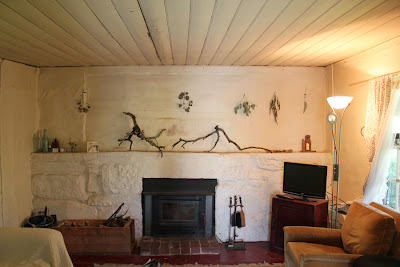
Mistletoe found object sculptures and drawings were also presented in my open studio and throughout the cottage (see work in progress). The uncanny animated shapes of these branches and the unusual haustorium, make these parasitic plants seem like sneaky scurrying aliens about to scuttle off and cause mischief. 

Kath Fries, Mistletoe - found object sculpture,
 Murray's cottage Hill End AIR, 2013

Kath Fries, Mistletoe - found object sculptures and liquid graphite stick drawings,
 Murray's cottage Hill End AIR, 2013

Kath Fries, Mistletoe - found object sculpture,
 Murray's cottage Hill End AIR, 2013

Kath Fries, Mistletoe - found object sculptures,
Murray's cottage Hill End AIR, 2013


Kath Fries, Mistletoe - found object sculpture,
Murray's cottage Hill End AIR, 2013

Kath Fries, Mistletoe - found object sculpture,
 Murray's cottage Hill End AIR, 2013

Kath Fries, Mistletoe - found object sculpture,
 Murray's cottage Hill End AIR, 2013

This cottage is named after Donald Murray, who lived here for over thirty years, he wrote "...artists are observant but selective in their observations. The surroundings of Hill End, both village and countryside, provide both material and time to observe without the distractions (stimulating though they are) that are inseparable from city life... We less fortunate mortals, have the unfortunate habit of being attracted by the obvious, the meretricious and showy, and wonder why we are so quickly bored. We can maybe learn the lessons of observation that artists of all time have taught us. The charms and beauties of Hill End are not easy to define. Much of it all is subtle and subtlety is not a very popular quality, particularly in this present age. We can be grateful to those artists who have carried some of the beauty and interest of this part of Australia to other lands and people."
(Donald Murray, November 1958, The Western Times)

Kath Fries, Mistletoe - found object sculptures,
 above the fireplace Murray's cottage Hill End AIR, 2013

Kath Fries, Mistletoe - found object sculpture,
by the front door of Murray's cottage Hill End AIR, 2013

I would like to thank Hill End artist-in-residence program www.hillendart.com.au, Bathurst Regional Art Gallery (BRAG) www.bathurstart.com.au and National Parks, for the opportunity to spend four weeks at Murray's cottage.

Week 2 - Hill End artist-in-residence

Kath Fries, Mistletoe collection and drawings in my Hill End studio, 2013

On my drive to Hill End from Sydney I noticed a number of strange, reddish, shaggy parasitic plants growing on gum trees, but I didn't know what they were. Now having been in Hill End for over two weeks, I've seen many more of them, found out they're called Box Mistletoe (Amyema miquelii), and collected pieces for my studio.

Kath Fries, Dead mistletoe branch, Hill End, 2013

At first I assumed mistletoe was an introduced pest, but I soon discovered that this variety is actually indigenous - one of Australia's 90 native species of mistletoe. There are about 1500 species are found across the world: characterised as perennial flowering plants, usually woody and shrubby or vine-like, which grow as parasites attached to the branches of trees and shrubs. 

Kath Fries, Mistletoe growing at Hill End, 2013


Mistletoe needs plenty of sunlight so it's usually seen in cleared areas, by the side of the road and in paddocks. This also explains its abundance around Hill End's large open spaces, which have been very slow to regenerate and recover from the environmental decimation of the 1870s gold mining boom. 

Kath Fries, Mistletoe growing at Hill End, 2013

Kath Fries, Mistletoe growing at Hill End, 2013

"The mistletoe is most popularly known through its place in ancient legends and mythology, and its widespread use in folk medicine. To the naturalist, however, its fascination stems from its unusual life history and its interactions with other plants and animals. To the biologist, in recent years, it has become a useful tool in research, and studies of mistletoe have contributed in a variety of ways to our knowledge of plant evolution. Research on mistletoes has furthered understanding of the origins of southern hemisphere vegetation, the evolution of mimicry in plants, the development of sexual differentiation or dioecy in plants, and of course the biology of parasitism."
Exploring the world of mistletoes, Australian National Herbarium

Kath Fries, Dead mistletoe, Hill End, 2013

Mistletoe is a hemi-parasite, taking water and minerals from its host but photosynthesising its own food - so it doesn't usually kill its host, only the single branch to which it is attached. But this means that when the host branch dies, so does the mistletoe - leaving behind a skeletal witch-like claw. The unusual branching structure and the haustorium (the point where the mistletoe attaches to the host branch) is a fascinating form and remnant of this unusual plant's life cycle. The undulations of the haustorium are fungal shaped - like the underside of a mushroom, marking the point of connection, transference and attachment, the lifeline of the mistletoe.

Kath Fries, Fallen mistletoe in Golden Gully, 2013

The word parasite comes the latinisation of the Greek παράσιτος (parasitos), "one who eats at the table of another" 

Kath Fries, Fallen mistletoe in Golden Gully, 2013

The haustorium forms when a sticky mistletoe seed is deposited on the host branch by the Mistletoe bird (after eating the mistletoe fruit). The sticky seed fastens onto the branch and within days a tiny tendril emerges from the seed, growing quickly and secreting a cocktail of enzymes directly onto the corky outer protection of the branch. Unable to resist the onslaught, the bark yields a small ulcer-like hole into which the tendril probes, forming a modified root that seeks its way down into the sappy tree tissue forming a connection through which water and nutrients pass from the host to the mistletoe. This tendril grows into a complex root system melding into the woody structure of the host's branch, becoming a living part of the branch receiving all the nutrients that the foliage of the host plant receives. 

Kath Fries, Fallen mistletoe in Golden Gully, 2013

This fallen mistletoe plant that I found in Golden Gully, looked spider-like and seemed perfectly shaped to fit into into the entrance of a nearby old disused mineshaft. I awkwardly lifted it into place all the while feeling that there was something a little spooky about positioning the mistletoe there, as though it was crawling out from the dark shadowy depths of the tunnel, solidifying the presence of a ghost or an alien emerging from the depths.


Kath Fries, Mistletoe installation in Golden Gully, 2013

Kath Fries, Mistletoe installation in Golden Gully, 2013

Kath Fries, Mistletoe installation in Golden Gully, 2013

Despite the bright midday sunlight, this narrative element was further exacerbated by stories of the 1870s Chinese miners working in Golden Gully, who built their mine shafts in a round (rather than square) shape so that ghosts could not hide in the corners...

Kath Fries, Mistletoe branch in my Hill End studio, 2013
Kath Fries, Mistletoe on tip toes, Hill End studio, 2013

Back in my AIR studio in Murray's cottage I've continued to work with pieces of mistletoe, intrigued by their animated forms, precarious balance and vague sense of threatening invasion. Although they are an important part of natural ecology, parasites will always be interpreted as alien, foreign and invasive - my imagination leaps into cinematic sic-fi imagery! But closer to home, any sort of ordinary natural parasite on or in one's body (like fleas or tape worms) makes one's skin crawl and a disproportionate hysterical reaction is just a breath away.

Kath Fries, Mistletoe haustorium in my Hill End studio, 2013

Kath Fries, Mistletoe haustorium in my Hill End studio, 2013

The mistletoe haustorium is particularly interesting, the point where the mistletoe meets with and connects with the host branch - it is the face of the alien, the mouth of the leach - but safely dead, rendered harmless, frozen and still. Brought indoors, within a somewhat controlled environment, it becomes easier to isolate, interpret and analyse these responses, as the false (but reassuring) notion that humans are in control of our bodies and our surrounding environment is again restored.

Kath Fries, Collection of mistletoe outside my Hill End studio, 2013

Some references:
Exploring the world of mistletoes www.anbg.gov.au/mistletoe
Are mistletoes friend or foe? www.abc.net.au/science/articles/2004/03/05/2044992.htm
The mistletoe: it's as Australian as the gum tree www.theage.com.au/action/printArticle?id=2853351
Misunderstood mistletoe asgap.org.au/apol2006/jul06-1.html


Kath Fries, Dead mistletoe branch, Hill End, 2013


This Sunday is Hill End Open Studio Day!
10 artist's studios will be open to the public, including my artist-in-residence studio at Murray's cottage... more info www.hillendartscouncil.blogspot.com.au


Hill End Artists Open Studio Day, 22 Sept 2013
Kath Fries, Mistletoe in my Hill End studio on Margaret Olley's kilim rug, 2013

I would like to thank Hill End artist-in-residence program www.hillendart.com.au, Bathurst Regional Art Gallery (BRAG) www.bathurstart.com.au and National Parks, for the opportunity to spend four weeks at Murray's cottage.