Oyama - leaves and shadows

Kath Fries, Oyama, 2011, photograph

Another very hot day in Japan. 
At Oyama a branch grew over the top of a bamboo fence. 
The bright midday sun created beautiful shadows.

Kath Fries, Oyama, 2011, photograph

Japan

I'm writing this from Tokyo - my return flight is thanks to the 2010 Japan Foundation New Artist Award, which I won with my Facetnate exhibition Grove. I've just begun a three week journey around Japan to see art and be inspired. As well as Tokyo, I plan to visit Kyoto, Kyo-San, Naoshima, Hiroshima, Mt Aso and Yokohama Triennale... zooming around the country on the super speedy shinkansen bullet trains, with a JR (Japan Rail) pass thanks to the ArtStart grant program. 

A map of Japan


Applications for Facetnate 2012 close on 30 September - all artists and curators who can see an element of Japanese influence on their practice should consider applying. I highly recommend this chance to work with the Japan Foundation, for me it was a great experience and an valuable learning curve in my professional practice. 

Hold dear, 2011, bronze magnolia branch version

Kath Fries, Hold dear, 2011, bronze magnolia branch, nylon netting and charcoal,
dimensions 200 x 600 x 300 cm

Hold dear reflects on the grieving process; particularly the challenge of letting go of loved ones after they pass away. The work focuses on a magnolia branch cast in bronze alluding to our human attempts to render permanent a tree’s natural state of flux - to grow, bloom, die-off, disintegrate and regenerate. The bronze magnolia branch protrudes out of the wall, it’s shape conjures associations with the aging human body, gnarled joints and textured skin - a visual record of a life lived, challenges endured and experiences weathered. As such, the nylon netting dragging the mound of charcoal across the floor suggest our human attempts to resist death and the anticipated prior natural course of aging.


Kath Fries, Hold dear, 2011,
bronze magnolia branch and nylon netting (detail view)


Hold dear, is a new version of a work by the same name first exhibited at Hidden Sculpture Walk in Rookwood Cemetery earlier this year. This version, with the bronze branch, was created specifically for the Fauvette Loureiro Memorial Artists Travel Scholarship Finalists Exhibition, on show until 23 September 2011 at SCA Galleries Rozelle.


Kath Fries, Hold dear, 2011, detail view of bronze magnolia branch

This magnolia branch cast directly into bronze, marks my first venture into the world of bronze casting. Many thanks to Matt Crawford and the team at Crawfords Casting for being enthusiastic about my project and allowing me to watch the bronze branch be constructed and finished in the foundry.

Kath Fries, Hold dear, 2011, detail view of netting and charcoal on gallery floor


Swash - rope, feather and high-tide installation


Swash was created for Strand Ephemera, a ten day sculpture walk event in Townsville, Queensland Australia, September 2 - 12 2011.

Kath Fries, Swash, 2011,
rope, feathers and high-tide mark, 200m long

The work spanned 200m tracing the area just above the high-tide mark across the sandy beach between two small headlands.


Kath Fries, Swash, 2011, rope, feathers and high-tide mark, 200m long

'Swash' is a meandering path of feathers tracing the high-tide mark. The word 'Swash' means splash or spray area above the high-tide mark but it is not a fixed demarcation, it moves with the littoral drift affected by weathering, human coastal development, storms and the passage of time. This line of feathers fluttering in the breeze, vulnerably dwarfed by the length of beach and nervously just out of reach of the enormity of the ocean, compels viewers to anthropomorphically see the feathers embedded in the sand as themselves standing so small against the forces of nature and the passage of time. 
Kath  Fries, artwork statement 2011


Kath Fries, Swash, 2011, rope, feathers and high-tide mark, 200, long

Kath Fries, Swash, 2011,
rope, feathers and high-tide mark, 200m long

Kath Fries, Swash, 2011, rope, feathers and high-tide mark, (detail)

Kath Fries, Swash, 2011,
rope, feathers and high-tide mark, 200m long

Kath Fries, Swash, 2011, rope, feathers and high-tide mark, 200m long

Kath Fries, Swash, 2011,
rope, feathers and high-tide mark, 200m long
(detail view of section where the tide washed over the work)

Kath Fries, Swash, 2011, rope, feathers and high-tide mark, 200m long

Kath Fries, Swash, 2011, rope, feathers and
high-tide mark, 200m long, (early morning)

Kath Fries, Swash, 2011, rope, feathers and
high-tide mark, 200m long, (sunrise)

2011 Fauvette Loureiro Memorial Artists Travel Scholarship - Finalists Exhibition


I'm one of five finalists in the Fauvette Loureiro Memorial Artists Travel Scholarship. Our work is being exhibited at Sydney College of the Arts Galleries, 8 - 23 September 2011.

The scholarship celebrates a bequest of the late Renee Fauvette Erdos in memory of her mother Fauvette Loureiro, the eldest daughter of artist Arthur Loureiro. Recent Sydney College of the Arts graduates can apply for a scholarship of $28,000 to further their visual arts practice and professional development in international environment. 

Swash - installation for Strand Ephemera, QLD

Strand Ephemera Exhibition Catalogue, Swash, Kath Fries, page 11


'Swash' is a meandering path of feathers tracing the high tide mark. The word 'Swash' means splash or spray area above the high tide mark but it is not a fixed demarcation, it moves with the littoral drift affected by weathering, human coastal development, storms and the passage of time. This line of feathers fluttering in the breeze, vulnerably dwarfed by the length of beach and nervously just out of reach of the enormity of the ocean, compels viewers to anthropomorphically see the feathers embedded in the sand as themselves standing so small against the forces of nature and the passage of time. 

(Kath Fries, Swash artwork statement 2011)


Strand Ephemera Kid's Education Program, Swash, Kath Fries, page 11
Strand Ephemera is an 11 day festival of contemporary art, 2 - 12 September 2011, Townsville, Queensland, Australia. Presented along the length of the Strand, Townsville's idyllic beachfront, this is the sixth incarnation of Strand Ephemera
“Ephemera” is a creative element to be interpreted by artists in any possible way. It can simply refer to the short life span of the exhibition, or as an encouragement to be innovative in the use of materials – accessible, organic, or as some artists interpret the brief, to produce work that disintegrates over the period of the exhibition. 
More info


Congratulations Sanné Mestrom - JFMP2011 winner

Congratulations Sanné Mestrom - winner of the John Fries Memorial Prize 2011 for emerging visual artists.  Mestrom was announced as the winner of the $10,000 prize at the finalists exhibition opening, Tuesday 9th August, at Viscopy’s contemporary art space in Chippendale, Sydney. The prize was presented by benefactor Vivienne Fries and acclaimed Sydney artist, Lindy Lee, who commented on the excellence of each of the finalists artworks and the consistently high standard of the exhibition.

The finalists and the winning entry were selected by a panel of judges including Anna Davis (Museum of Contemporary Art curator), Hannah Bertram (artist and John Fries Memorial Prize winner 2010), Danie Mellor (artist and Telstra National Aboriginal & Torres Strait Islander Art Award winner 2009) and Kath Fries (artist, Viscopy Board member and John Fries' daughter). 

Sanné Mestrom, Thinking Props, 2010, 120x100x100cm, Mixed media sculptural installation, (wood, bronze, resin, found broom stick, copper). Image courtesy the artist.

Mestrom's sculptural installation Thinking Props plays with the idea of a physical prop designed to promote cerebral and psychological contemplation.   Made from everyday found objects, the work consists of three components: a table, a cluster of door handles and a “joy prop”.  Her table is tailored to one assuming the classic position of Auguste Rodin's The Thinker, with elbow placed on table enclave and chin on cupped hand.  It is a physical prop that encourages cerebral revelation.  A grid of door handles below the table suggests opening doors, that endless possibilities and zones of discovery are just a simple action away.  In front of the table sits a “joy prop” constructed of a cast bronze mould hypothetically designed to be fitted into the mouth to force a smile. 

Danie Mellor says of the Mestrom’s artwork: Through her interest in human intimacy ... she presents playful and thought provoking arrangements of objects that recall Modernist engagements with the readymade... (but) an intimacy is invoked that allows a bodily interaction with form, if only through the viewers’ realisation that in fact "this is what you (can and are supposed to) do" with the objects.  They are both familiar and out of reach as fragile objects in a gallery space, a temptation for the curious. The complexity of the potential interaction that the installation suggests, and its resolution as an intricate and multi-layered object, lends this work its intrigue and place as a well deserving winner.

Mestrom's winning artwork, Thinking Props features in the exhibition with the other fourteen finalists: Cyrus Tang, Erica Molesworth, Eva Hampel, Heath Franco, Jennifer O'Brien, Karl Khoe & Tessa Zettel, Keiko Matsui, Kristel Britcher, Kurt Sorensen, Nathan Taylor, Pauletta Kerinauia, Sanné Mestrom, Susie Nelson, Wade Marynowsky and Walter Brecely. Curated by Venita Poblocki, runs until 30 September and is open between 1pm and 5pm from Wednesday to Friday. 1 Blackfriars Street Chippendale NSW 2008 Australia.

The John Fries Memorial Prize for emerging visual artists is an annual prize donated by the Fries family in memory of former Viscopy director and honorary treasurer, John Fries, who made a remarkable contribution to the life and success of Viscopy.  The competition is open to emerging Australian and New Zealand artists of all ages and disciplines who are not currently studying and whose work has not yet been collected by a regional, state, territory or national public gallery.

For more information about Sanné Mestrom's practice please see her website www.mestrom.org and for more information about the John Fries Memorial Prize 2011 please see Viscopy's website www.viscopy.org.au/current-exhibition

John Fries Memorial Prize Exhibition 2011

John Fries Memorial Prize 2011 for emerging visual artists
Finalists exhibition: 9 August to 10 September 2011

The winner of the $10,000 award
will be announced at 7pm on Tuesday 9 August

Blackfriars off Broadway - Viscopy’s exhibition space
1 Blackfriars Street, Chippendale NSW 2008, Australia
Open 1 to 5pm Wed to Fri. (02) 9310 2018 http://www.viscopy.org.au/  


The finalists are: Cyrus Tang, Erica Molesworth, Eva Hampel, Heath Franco, Jennifer O'Brien, Karl Khoe & Tessa Zettel, Keiko Matsui, Kristel Britcher, Kurt Sorensen, Nathan Taylor, Pauletta Kerinauia, Sanne Mestrom, Susie Nelson, Wade Marynowsky and Walter Brecely.

The John Fries Memorial Prize 2011 finalists’ exhibition showcases the diversity of mediums being used by current emerging artists. The exhibition includes site-specific interactive works and responsive installations involving robotics, touch, movement and sound as well as paintings, glass, porcelain, photography, sculpture and video. However, regardless of medium, the works represent contemporary artistic preoccupations including the nexus between object and process, self and culture, interactivity and audience, technology and viscera, nostalgia and time.

The exhibition has been curated by Venita Poblocki. The finalists and the winner have been selected by the judging panel: Anna Davis - Museum of Contemporary Art Curator, Hannah Bertram - John Fries Memorial Prize 2010 winner, Danie Mellor - National Aboriginal & Torres Strait Islander Art Award winner 2009, and Kath Fries - artist and Viscopy board member.

The John Fries Memorial Prize for emerging artists is open to Australian and New Zealand artists of all ages and disciplines, who are not currently studying and whose work is not yet included in a public art collection. The John Fries Memorial Prize is an annual non-acquisitive prize, donated by the Fries family in memory of John Fries, former Viscopy director and honorary treasurer who made a remarkable contribution to the success of Viscopy.

For more information visit www.viscopy.org.au/current-exhibition

ArtStart Grant Recipient

www.artstartgrant.com.au
I'm thrilled to be a recipient of an ArtStart Grant from the Australia Council for the Arts. This grant will invest $10,000 over the next twelve months in my career as a visual artist. 


This money will go towards the design, development and promotion of my new professional artist website; promotion, documentation and marketing of my artwork; my studio rent at Primrose Park Studio July to December 2011 supported by North Sydney Council, and Parramatta Artists Studios January to July 2012 supported by Parramatta Council; and a bullet train pass for my research and development trip to Japan in September, with flights supported by the Facenate Program at the Japan Foundation.

Over these next twelve months I will continue to exhibit my work, first at Strand Ephemera in Townsville QLD in September and at Primrose Park Cremorne NSW in December. Next year, in march I will present a solo exhibition at Gallery Eight in Millers Point, Sydney and in April I will also be exhibiting whilst artist-in-residence at 'ACE in Buenos Aires, Argentina. 

Throughout this time I will remain on the board of Viscopy and involved in the John Fries Memorial Prize for emerging artists, as well as continuing to be the co-ordinator of the Gunyah artist-in-residence program in North Arm Cove, Port Stephens NSW.

A big thank you to Lindy Lee for agreeing to mentor me and also to the staff at Gaffa Gallery and Megan Robson for their on-going interest in and support of my work.

I will continue to keep this blog updated with my art projects relating to my ArtStart Grant as they develop - so stay tuned!


Strand, 2011

This work, Strand, was one of nine finalist entries selected for The David Harold Tribe Sculpture Award at Sydney University, exhibited at Sydney College of the Arts Gallery, June 2011.
Kath Fries, Strand, 2011, synthetic hair extensions,
electrical cord and light bulb, dimensions variabl

Strand was created recently whilst I was artist-in-residence at The Lock-Up in Newcastle. It is one of several works I developed as part of my explorations of the confines of the old dark cells of the historic jail, considering how one would dream of escape and perhaps find it internally within one’s mind. The fabrication of Strand suggests deranged pulling and twisting of hair, the disturbed mind increasingly unbalanced by incarceration and disconnection from the world. Hair - an apparently abject bodily material conjures strong visceral responses, as well as associations with narratives and histories where hair is a focal point, such as the practice of shaving prisoners’ heads and the Rapunzel fairytale.

The David Harold Tribe Sculpture Award Exhibition


The aim of the David Harold Tribe Sculpture Award is to promote interest in sculpture and to encourage the creation of sculpture in Australia, to help and give incentive to sculptors and to provide them with additional monetary amounts thus enabling them to further their education in the field of sculpture and enabling them to improve their creative skills and through the above means to improve the general public appreciation of sculpture. 

The Award of $12,000 will be announced at the exhibition opening Wednesday 1 June 2011, 6 -8 pm. Sydney College of the Arts Galleries, Balmain Road, Rozelle, NSW.

More info here

Twilit melodrama

Kath Fries, Confine v, 2011, hessian rope and shadows, The Lock-Up Cell E
"...In the old prison cells surrounding the main gallery, artist in residence Kath Fries uses nets, cords, rope and reflections to further enhance the atmosphere of sombre oppressiveness. 
Rarely have the prison ambiences of the complex been so dramatically realised. It is a strange experience to go from the clean spaces of the main exhibition into a twilit melodrama..."
(Jill Stowell, Newcastle Herald, Saturday 7 May 2011, page 18)

Confines, The Lock-Up, 29 April to 15 May 2011

Confines, a series of site-sensitive installations by Kath Fries
29 April to 15 May 2011
The Lock-Up, 90 Hunter Street, Newcastle, NSW 2300
Open: Wednesday to Sunday 10am – 4pm

Confines is a series of site-sensitive installations by Kath Fries, the current artist-in-residence at The Lock-Up, Newcastle. In these works Fries has used tactile everyday materials to explore and describe the perimeters and penetrations of each space, consciously leaving room for the viewer’s own personal associations, interpretations and narratives to be developed. Whispers of ghost stories permeate these spaces, manifesting in Fries’ installations as a sense of tension, balancing on an edge between the immediate present and unfurling possibilities of the unseen.


Confines: the boundaries, limits, or scope that restricts somebody or something
Confine: to keep within certain limits or boundaries, to keep somebody or something from leaving an enclosed or limited space 


“My installation practice begins with the premise of responding to the location of each work in a site-sensitive manner. But, in a building as heavily laden with a sense of historical presence as The Lock-Up, it has been all the more challenging to respond to the dynamics of these spaces and enhance their sensibilities without sidetracking or detracting from what they are. Working on an intuitive level and focusing on my gut reaction to being in each of the spaces (forcing myself to remain there for hours at a time whilst making the works), I explored the physical boundaries of the cells particularly the permeation points. Not just the doors for human access, but more particularly how light, air and sound came into, out-of and move around each of the spaces. Tactile everyday materials are used in Confines to track and enhance these potential paths of movement. During the process of developing these works the notion of art as escapism became particularly apparent and the possibility of escaping in any form was very appealing.” (Kath Fries, April 2011)

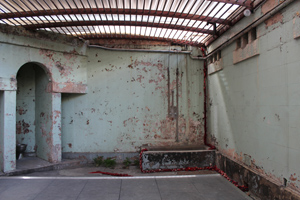
Locations of Kath Fries' Confines installations in The Lock-Up

---


Confine i, 2008 - 2011
Mirrors, DVD and audio loop, projector, found wire and tangled vine
(Cell F: Women’s Cell)
A small barred window allows a little light in and the expansive imagination out – it becomes the passageway for dreams and longing, a focal point within the cell to access the world outside. On the cell floor, the window grid is repeated in an arrangement of mirrors, onto which is projected video footage of a leaf filament caught in a spider’s web. This skeletal silhouette slowly flutters in the wind, caught in limbo between heaven and earth but unable to connect with either.

Kath Fries, Confine i, 2008 – 2011

---


Confine ii, 2011
Synthetic hair extensions, power cord and light bulb
(Cell G: Women’s Cell)
The deranged pulling and twisting of hair forms a disturbing image of incarceration and disconnection from the world. Here the use of an apparently abject bodily material conjures strong visceral responses as well as associations with narratives and histories where hair is a focal point, from the practice of shaving prisoners’ heads to the Rapunzel fairytale.
Kath Fries, Confine ii, 2011


---


Confine iii, 2010-2011
Feathers, foam furniture stuffing and rope
(Cell B: Men’s Cell)
Just as humans may pull out their hair under intense stress, birds have similarly been observed plucking out their own feathers in states of extreme anxiety. Here a flotsam of feathers sits incongruously against the hard concrete cell. More feathers seemingly creep along a length of rope leading a way out of the space via an obscure corner drain and a high small window. Amongst the graffiti carved into the walls is the word FLY, surrounded by feathers it hints at fantasies of an Icarus* style escape. Outside the pigeons continue to coo insistently.

* In ancient Greek mythology Icarus and his father famously attempted to escape imprisonment by creating wings from feathers and wax to fly over the walls of the Cretan Labyrinth and across the sea beyond.

Kath Fries, Confine iii,  2010-2011
Kath Fries, Confine iii, 2010-2011

---

Confine iv, 2011
Nylon netting and padded walls
(Cell C: Padded Cell)
One edge of netting is drawn taut across the diagonal of the cell before cascading to the doorway floor. Purporting to be a safety net, but just like the padded cell, this grid of thread is fallible, fragile and torn. The human psyche remains largely unpredictable and unknown, there is still no failsafe way to secure a person’s life or sanity or freedom.
Kath Fries, Confine iv, 2011

---

Confine v, 2011
Hessian rope and shadows
(Cell E: Men’s Cell)
Shadowy grids score the floor with light and dark, echoing the cell’s barred windows. Hessian ropes hang suspended, reminiscent of hammocks swinging within a sailing ship’s wooden hull and colonial transportation.
Kath Fries, Confine v, 2011

---

Confine vi, 2009 – 2011
Hand braided recycled fabric and concrete bathtub
(Exercise Yard)
The yard was constructed and concealed for male inmates’ exercise and ablutions, their view of the sky was restricted as was the post office worker’s view of the prisoners. Constructed by hand from torn rags, this work traces the flow of water into and out of one corner of the yard, pointing to the drains and hitherto unseen open expanse of sky above.

Kath Fries, Confine vi, 2009-2011