Permeate installation

Kath Fries, Permeate, 2015, beeswax and sandstone shards, 300x400x600cm

Permeate is an immersive installation reflecting on my experiences of sitting quietly on a rocky outcrop overlooking Wollemi National Park, each evening while I was an artist-in-residence at BigCi, Bilpin NSW. These were contemplative engagements with site, observing my surroundings as the late afternoon light and shadows changed with the setting sun then merged into twilight, which conjured an embodied sense of present time, of completely being there. My awareness incorporated not just what I could see - the view and the tree tops - but also the smell of the air as I breathed in and out, the touch of the cold sandstone I was sitting on, and my emotive state. Beyond my bodily boundaries I could also sense the ancientness of the rocky escarpments, supporting diverse and intriguing ecosystems that are mostly unseen by our human eyes, yet felt on other levels.

Kath Fries, Permeate, 2015, beeswax and sandstone shards

In the gallery, a dark secluded space houses Permeate, this separateness invites the viewer to feel immersed in the work without distractions. It offers the potential for embodied sensory contemplation, experiencing the honey fragrance of the beeswax, the tactility of the jutting sandstone shards and the wall’s dripping splatters of beeswax that seem to ooze from within. Each rock consists of its own layers of historical time, coloured with clay, ochre, grit and sand; like rock-climbing-handholds each stone can be plateau for one’s eyes and thoughts to rest upon, or jump between rock-hopping through a micro interpretation of the Bilpin Wollemi landscape, of imaginative reflection and exploration.

Kath Fries, Permeate, 2015, beeswax and sandstone shards, (detail view)

One of the most intriguing and unique aspects of the geological ecosystems in the Bilpin Wollemi area, is the poetically named 'hanging swamps', which are formed over long periods of time as the thick porous sandstone cliffs absorb large amounts of rainwater, like giant sponges. This water builds up against the thinner impermeable strata layers of claystone and ironstone, shunting it sideways along the resistant stratums, so the groundwater trickles out continuously, providing constant moisture. The reliable dampness forms patches of swamp conditions with damp peat-rich soil, which nurtures and sustains the surrounding vegetation on the seemingly inhospitable steep rocky escarpments. 

Kath Fries, Permeate, 2015, beeswax and sandstone shards, (detail view)

Permeate's jutting rocks were collected in the Bilpin Wollemi region near some hanging swamps. Most of the pieces are the size of my hands, the act of holding and collecting them formed an additional physical engagement with materiality and site, which was developed further as I scrubbed away layers of dirt from the stones, revealing their colourful contrasting strata layers. 

Kath Fries, Permeate, 2015, detail view - beeswax on wall 

The beeswax in Permeate echoes the rain precipitation and seeping movement of the water in the hanging swamps. It also refers to another layer of the ecosystem’s interconnections, that of bees and other insects pollinating the trees and plants of the area, which often go unseen and unacknowledged by us humans looking at the landscape.

Kath Fries, Permeate, 2015, beeswax and sandstone shards, (detail view)

My residency at BigCi Bilpin, contributed to my PhD practice-led research into embodied engagements with materiality and their capacity to be synonymous with present time experience. By working with site-responsive processes, seeking ways to connect with place and aspects of nature through the entanglement of our senses with our surroundings, culminated in experimentations with tactile found materials to reflect on my personal experiences of the site and more broadly on the passage of time and fragility of life. 

Kath Fries, Permeate, 2015, beeswax and sandstone shards

I would like to thank Hawkesbury Regional Gallery for giving me the opportunity to create this work in their gallery as well as organising and supporting my residency at BigCi. My Permeate installation was part of the group exhibition Exploring BigCi, 19 June - 2 August 2015, shown along with work by previous BigCi artists-in-residence: Hyewon Hye Shim (Korea), Nandita Mukand (Singapore), Claudia Luke (Germany), Nicola Moss (Queensland), Chris Dolman & Paul Williams (Sydney), Crisia and Andrei Miroiu (Romania), and Rachel Peachy & Paul Mosig (Katoomba).


Kath Fries, Permeate, 2015, beeswax and sandstone shards


Hawkesbury Regional Gallery - Exploring BigCi


Kath Fries, Permeate (work in progress), 2015, beeswax and sandstone

Over the past five weeks I've been visiting Bilpin and working in the BigCi Art Shed, developing an installation for Hawkesbury Regional Gallery. This project is part of my research into embodied engagements with materiality and their capacity to be synonymous with present time experience. Working in a site-responsive manner, seeking to connect with place and ideas of nature through the entanglement of our senses with our surroundings, I explored the landscape and water catchments of the Bilpin area, and was particularly intrigued to learn about the local hanging swamps.

Kath Fries, Permeate (work in progress), 2015, beeswax and sandstone

Permeate, my installation for Hawkesbury Regional Gallery, is created from beeswax and shards of sandstone collected around the BigCi property, and inspired by the poetically named ‘hanging swamps’ found in the steep rocky escarpments of the Bilpin area. Hanging Swamps are unique geological ecosystems, formed over long periods of time as the thick porous sandstone cliffs absorb large amounts of rainwater, like giant sponges. This water builds up against the thinner impermeable strata layers of claystone and ironstone, shunting it sideways along the resistant stratums. The groundwater then trickles out continuously, providing constant moisture and forming swamp conditions with damp peat-rich soil, which nurtures and sustains the surrounding vegetation on the seemingly inhospitable steep rocky escarpments. The beeswax in this installation echoes the precipitation, permeation and seeping water movement in the hanging swamps. It also refers to another layer of the ecosystem’s interconnections, that of bees and other insects pollinating the trees and plants of the area. So the beeswax conjures a metaphorical suggestion of our disparaging human attitudes towards insects despite their vital role in sustaining life.

Exploring BigCi - exhibition invitation

Permeate will be exhibited at Hawkesbury Regional Gallery in Exploring BigCi, a survey exhibition of international and Australian artists' work created at the Bilpin international ground for Creative initiatives residency.

Artists: Hyewon Hye Shim (Korea), Kath Fries (Sydney), Nandita Mukand (Singapore), Claudia Luke (Germany), Nicola Moss (Queensland), Chris Dolman & Paul Williams (Sydney), Crisia and Andrei Miroiu (Romania) and Rachel Peachy & Paul Mosig (Katoomba).

Opening event: 6-8pm Friday 19 June
exhibition continues to 2 August 2015

Discussion panel: 1-2pm Saturday 20 June 
with artists Kath Fries, Chris Dolman and Paul Williams; and Rae Bolton (BigCi coordinator) and Diana Robson (exhibition curator)

Hawkesbury Regional Gallery
Deerubbin Centre (1st Floor), 300 George St, Windsor NSW 2756
Open: Mon, Wed, Thur & Fri 10am-4pm, Sat-Sun 10am-3pm

Sun-panels: site responsive installation at BigCi

Kath Fries, Sun-panels, 2015, beeswax, found stones and branch, sunlight and shadows,
BigCi Art Shed, Bilpin, NSW

Over the past few weeks I've been visiting the BigCi art shed, making work and exploring the area, thanks to the support of Hawkesbury Regional Gallery. Warm morning sunlight streams into the art shed, thawing out the chill of mountains' winter weather, and these pools of sunlight seemed to direct how I inhabited the space. Working in such an unusually large studio space enabled me to pour numerous fragile beeswax panels and gently spread them out across the extensive concrete floor. 

Kath Fries, Sun-panels, 2015, beeswax, found stones and branch, sunlight and shadows, 
BigCi Art Shed, Bilpin, NSW

The beeswax sourced from Malfoy's, also in the Blue Mountains, was an extremely rich yellow colour due to its freshness and the types of pollen and nectar that the bees had collected. Although I liked the vibrancy of the colour and its associations of lively pollination and thriving health, it was really too bright and intense for my purposes. Hoping that the sunlight would naturally cause the wax to fade, I tried moving the panels into patches of sunshine funnelled into the studio via the huge roller doors. In the process of repositioning these panels - chasing the pools of sunlight that shifted over the course of the morning - my traces of movement developed into an installation in itself. I documented the playful lines and shapes of my beeswax panels in the space as they changed in relation to the sunlight and shadow transitions.

Kath Fries, Sun-panels, 2015, beeswax, sunlight and shadows, detail view

Kath Fries, Sun-panels, 2015, beeswax, found stones and branch, sunlight and shadows

Kath Fries, Sun-panels, 2015, beeswax, found stones and branch, sunlight and shadows

BigCi - Bilpin international grounds for Creative initiatives, is located on the edge of the Blue Mountains National Park and Wollemi National Park. During my visits I've been exploring the rocky escarpments and water catchments of the area, and was intrigued to learn about the poetically named 'hanging swamps' and their vital roles in maintaining the local ecosystems. For my upcoming installation work at Hawkesbury Regional Gallery in Windsor, 19 June - 2 August 2015, I’ve collected sandstone shards and branches from the area, and dripped them with beeswax to echo the layered interconnections between precipitation and geology which has evolved to support the unique flora and fauna of the area. 

Kath Fries, Sun-panels, 2015, beeswax, found stones and branch, sunlight and shadows

Kath Fries, Sun-panels, 2015, beeswax, found stones and branch, sunlight and shadows


Resident Spotlight - May 2015 Kath Fries, bigci.org/artists-in-residence

ACCREATION: UN-BECOMING AND THE SURFACE AS SIGHT


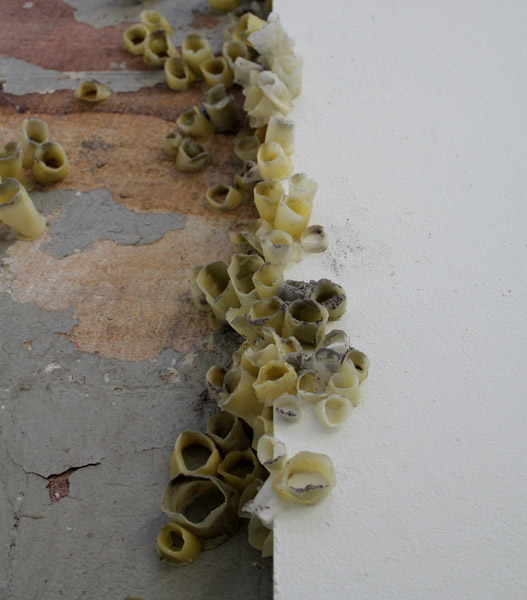
Kath Fries, Divest, 2014, beeswax and ash, detail view, SCA Galleries

ACCREATION: UN-BECOMING AND THE SURFACE AS SIGHT
Niall Robb, Laura Hunt, Kath Fries, 
Alma Studholme and Charlotte Richardson

Verge Gallery, Darlington NSW
Opening 6-8pm Thursday 18 June, continues to 11 July 2015

Accreation: Un-becoming and the Surface as Sight brings together five artists from disparate practices, each exploring surface as a site of the imperceptible, and the space between process and actualization of work. Robb understands surface as a sight of enchantment, coupling the circulatory nature of moving image with the materiality of surface to explore the imperceptible in a space between reality and mythology. Richardson’s bespoke jewelry pieces explore the everyday, collapsed and reformed. Her up-cycled domestic plastic products hold an uncanny sensibility, forming a new relationship with the viewer via the mirrored surface. Hunt’s practice is based in the documentation of action, she takes imperceptibility of sound as an ever-evolving and circulatory surface. Fries installations looks at the ephemerality of the physical surface as a site of creation, suggesting impermanence and transience. In Firing Enzo, Studholme draws on the properties and processes of the ceramic material. In the process of documenting her work, Studholme reveals slippage inherent in process, and the impossibility of control. The resulting works transform the gallery into a many-layered space of to uncover and re-imagine the surface of things.


Kath Fries, Divest, 2014, beeswax and ash, detail view, Articulate Project Space

For this exhibition I will be installing a rendition of Divest, my beeswax and ash sculptural installation series that explores uncontainablity and porous intersections between artifice and nature. In this work, beeswax polyp forms cluster in a vertical crevice, seemingly seeping inwards to gradually invade the gallery space. These aromatic translucent shapes suggest embodied presence but their surfaces are smattered with ash, which in turn conjure a sense of uneasiness, vulnerability and loss. 
The engagement with process and space in Divest, reflects my practice of tracing the impermanence of present experience, as an ongoing tangible engagement with the passage of time and fragility of life. Working with tactile materials to explore interconnections between our senses and our surroundings, this sculptural installations is quiet, sensitive engagements with site and materiality. 
For more about my Divest installation series see kathfries.com

Kath Fries, Divest, 2014, beeswax and ash, detail view, SCA Galleries

ACCREATION: UN-BECOMING AND THE SURFACE AS SIGHT
18 June - 11 July 2015

Verge Gallery
City Road, Darlington, NSW 2006
Enter via: Jane Foss Russell Plaza, University of Sydney
Open: 10-5 Tues to Fri, 11-4 Sat