Snow and ash palisades - Arteles Finland

Kath Fries, Palisade, 2015, snow and ash, Finland

There's a little yellow painted wooden cabin set a short distance away from the other buildings, on the edge of the forest. This cabin houses a traditional Finnish wood burning sauna, built in 1961 and still used regularly by the staff and artists-in-residence at Arteles Creative Centre. In Finland, sauna is one of the most important cultural practices and traditions - the sauna is considered an almost sacred space, even more so than church for many people. Preparing and using the wood burning sauna is a lengthy, ritualised and contemplative activity. 

Kath Fries, Arteles Sauna, 2015

The sauna is central to Finnish life, children are taught and expected to act respectfully and calmly in the sauna. Traditionally it was the place to give birth and to wash new born babies due to the warm and almost sterile conditions, for the same reasons the sauna was also the place where healers did their work, and where dead bodies were washed and prepared for burial. So the sauna - a small cabin of wood, steam and fire - was the site of the beginning and ending of life. In a more everyday sense the sauna is also an important place for the family to relax and spend time together, and this continues today. The first records of built saunas in Finland date back to the fifth century, but the ancient nomadic Finns dug spaces into the ground to heat up water for bathing. Even today, every household that can afford to build a sauna will do so, and there are over 2 million saunas in Finland for its 5 million inhabitants. I repeatedly hear that Finns think of saunas not as a luxury, but as a necessity. 


Kath Fries, Palisade, 2015, snow and ash, Finland

The traditional wood burning sauna at Arteles has been the most authentically Finnish cultural activity of my residency (although I did encounter some Finnish karaoke at the local pub on Saturday night!). On the second day of our residency, Reetta, Arteles' program co-ordinator, showed us specifically how to build, maintain and use the sauna, so we've been able to incorporate this traditional cultural activity into our time here. It's quite labour intensive and somewhat ritualistic building the fires and ladling water to prepare the sauna, but from an artist's view of process - the physical engagement in a specific series of time consuming activities are significant in themselves. And then the saunaing which follows is relaxing, warming and rewarding - especially in contrast to the cold snow outside. 

Kath Fries, Palisades, 2015, snow and ash, Finland

Before building the fires, the ash from previous saunas has to be removed, usually it is scattered on the snow around the trees behind the sauna cabin. Scattering ash, even when it's an everyday domestic act, always seems to be poetic and ritualistic. In my mind this is intrinsically linked to cremation and grieving. A number of my works over the past few years have incorporated ash, as ash is what remains when life has departed, from a tree or a human body. For me scattering wood ash is ritualistic and recalls my father’s death and cremation in 2009. The grieving process does not fit neatly into our normal notions of daily time, measured by clocks and calendars; it ebbs and flows for each person differently with various scales of intensity. Ash is an embodiment of impermanence - especially the weightlessness of the ash as it floats through the air, demonstrating quite a different relationship to gravity than that which we're used to. I was fortunate to be at the performative opening event of Zhang Huan's 20-tonne-incense-ash 'Sydney Buddha' installation shortly before I left home for my residency in Finland. Ash is a material that always appeals to me, and when Reetta mentioned scattering the ash on the snow under the trees, I sensed an idea for a potential artwork and decided to collect the ash to make an installation scattering it intentionally. 

Kath Fries, Palisade, 2015, snow and ash, Finland

In Finnish mythology, all things - trees, water, stones, fire, animals, plants and buildings have Haltijat, guardian spirits, which sometimes manifest as Väki - little elves.  Most of the specifics of these pagan beliefs have been lost over time, but interestingly the sauna elf is still remembered. At the end of saunaing the final ladle of water poured on the hot stones on departure, allows elf spirit to enjoy the last of the sauna's warmth in peace. Gifts are also left for the sauna elf especially during Christmas. Whether intentionally or not, I've noticed a few of our unfinished sauna beers have been left in the snow outside the sauna door - and I like to imagine the Arteles' sauna elf enjoys these in the remaining steamy heat of the sauna after we have vacated.

Kath Fries, Palisade, 2015, snow and ash, Finland

With the sauna elves in mind, and the ephemeral materials of snow and ash to hand, I selected a site near the sauna cabin on the edge of the forest. There I made a group of knee high, hollow snow pillars and filled them with ash from the sauna. The sizes and forms looked similar to some nearby tree stumps and related to my vague notions of sauna elves watching over their special sites. I've called this installation Palisades - a palisade is a protective stake wall, handmade from tree branches. Over the following week the weather changed, with warmer temperatures and a pre-spring thaw. This became an essential component of my Palisades work as the outer layers of snow melted away and then re-froze, exposing the ashy core within. 

Kath Fries, Palisade, 2015, snow and ash, Finland

My participation in this residency has been made possible with the support of The Ian Potter Cultural Trust, supporting Australian emerging artists to develop their skills and gain experience through international professional development opportunities,ianpotterculturaltrust.org.au, and NSW Artists' Grant Scheme, an Arts NSW's devolved funding program administered by the National Association of the Visual Arts on behalf of the NSW Government, visualarts.net.au/nava-grants.

Work in progress - Silence Awareness Existence

I've been in Finland for two weeks now, staying at Arteles Creative Centre, which is formally a school house and library. The buildings seem to nurture the reading, writing and art-making of its artists in residence. And on our doorstep is the forest - a wonderful 'once upon a time' landscape blanketed in snow.

Kath Fries, Snow Forest, 2015, Finland

At first the thick snow hid any chance of discerning the summertime walking paths in the forest. However Teemu, who runs the residency, suggested we wouldn't get lost as long as we just re-traced our footsteps back again. So we entered the fairytale forest and explored beneath the towering birch and conifer trees, initially wading through deep snow that came up to our knees and sometimes higher. Teemu's advice of retracing our footsteps proved to be easy to follow, and over the next few days our confidence grew and our tracks gradually wore into paths across the snow covered forest floor. But when venturing off the tracks I'm still startled if the surface gives way beneath my feet in unexpected directions, often disturbing a concealed branch and causing the other end to spring up behind me - like a seesaw. These physical demonstrations of interconnectedness buried beneath the snowy surface intrigues me and I've began thinking about the narratives of various life forms surviving, temporarily dormant, under the protective layers of snow.

Kath Fries, Snow Forest, 2015, Finland

Walking in the forest, I often pause to listen to the quietness and look up to the tops of the tall trees. The trees' branches are laden with snow, not heavy enough to break them, but significantly weighing them down. Sometimes in the silence I hear a slight noise off to the side, as a tree branch shifts it's burden and a shower of snow patters down - the branch springs away finally unencumbered and released to reach towards the sky again. This often seems to be the only perceptible movement in the quiet still forest. My initial experiments with mark making in the snow, echoed the tree branches shaking off their burdens. I gently spiralled small birch saplings around, releasing their snow coats and forming little tunnels in the snow surrounding them. 

Kath Fries, Twig tunnels, 2015, Finland
Kath Fries, Twig tunnels, 2015, Finland

Exploring beyond our regularly trodden paths, my limbs would often fall through the top layers of snow. Causing the embodied realisation that  we humans are unbalanced for this kind of terrain - ungainly walking on two legs, compared to the animals spreading their weight more easily across all four - their tracks across the snow blanket always look lighter, quicker and easier. I'm interested in how our bodies and senses engage with our surroundings, and there's something interesting about these repeated actions of my hands and arms, feet and legs reaching into the snow, grasping, reaching, falling and tunnelling. My next snow experiments involved using my hands and arms to create burrows in the snow,  forming interconnecting tunnels by reaching into the snow from two sides so that my hands met in the middle, hugging the snow. The resulting forms reminded me of rabbit warrens, with multiple entrances and exits.

Kath Fries, Snow burrow, 2015 Finland
Kath Fries, Snow burrows, 2015 Finland
Kath Fries, Snow burrow, 2015, Finland

My participation in this residency has been made possible with the support of The Ian Potter Cultural Trust, supporting Australian emerging artists to develop their skills and gain experience through international professional development opportunities, ianpotterculturaltrust.org.au, and NSW Artists' Grant Scheme, an Arts NSW's devolved funding program administered by the National Association of the Visual Arts on behalf of the NSW Government, visualarts.net.au/nava-grants.

Silence Awareness Existence artists-in-residence

Arteles Creative Centre Finland, February 2015, Kath Fries
I'm delighted to be at Arteles Creative Centre in Finland, for the February Silence Awareness Existence residency, with my fellow artists Sandra Beer (Germany), Angie Gunnoe (USA), Will Harris (USA), Antonia Kuo (USA), Constanza Gazmuri Lyon (Chile), Grace Peters (USA), Mauricio Rodriguez (Mexico), Louise Bøgelund Saugmann (Denmark) and Pia Zölzer (Germany). 

Arteles Creative Centre Finland, February 2015, Kath Fries

All the artists participating in this residency work with silence in some way. We each have slightly different cultural ideas about what silence is, and very personal ones about why and how we want to experience silence and work with it here. more info

View from Arteles Creative Centre Finland, February 2015, Kath Fries

Although I've only been in Finland for four days, during this time I've been interested to learn that the Finnish have their own very specific relationship with silence, and consider it an essential part of their culture. In Finland customs and culture (2005), Terttu Leney asserts that the Finns have a sincere respect for silence, and are comfortable with it. Finnish folklore praises the virtue of silence as a sign of wisdom, and silence continues to be seriously studied as a form of communication by Finnish academics. Long silent pauses in a social situations are regarded as perfectly natural, "… Silence at the dinner table does not bother the Finns, but it can feel very awkward to someone from the English-speaking world, who is accustomed to keeping the conversation flowing." Leney recounts how a British travel writer, trekking in Lapland with a Finnish guide, remembers such an encounter: "We had walked for two days without seeing anybody. Then I saw someone in the distance, coming towards us, and really looked forward to exchanging views about the beauty of Lapland in the full glow of autumn colours. The man came closer and closer, passed us with barely a nod, and continued on his way. I turned to my guide to ask why we didn’t stop to talk. The guide explained that this man would have come to the wilderness to enjoy the silence and to be alone, and that we had no right to disturb him."

Branch with snow in the forest near Arteles Creative Centre, Kath Fries

The Finnish cultural engagement with, and understanding of silence is very different to its negative associations in English speaking cultures, including my own. I’ve just begun reading Sara Maitland’s A Book of Silence (2008). She's a British writer and feminist, describing herself as a ‘seeker of silence’. In the first chapter, Growing up in a noisy world, Maitland describes how we generally live very noisy lives - we choose to have incessant sound pumping into our environments, homes and ears, then feel uncomfortable or scared when we have to confront real silence. Although "we all imagine that we want peace and quiet... we seldom seek opportunities to enjoy it. We romanticise silence on the one hand and on the other feel that it is terrifying, dangerous to our mental health, a threat to our liberties and something to be avoided at all costs.” Despite these customary views, Maitland values silence as a positive, nurturing and creative way to engage with existence, and I agree. She says "Silence is not an absence of sound but the presence of something which is not sound … there is an interior dimension to silence, a sort of stillness of heart and mind which is not a void but a rich space … as a whole society we are losing something precious in our increasing silence-avoiding culture and that somehow, whatever this silence might be, it needs holding, nursing and unpacking."

Tall trees in the forest near Arteles Creative Centre, Kath Fries

Here in Finland, amongst the like-minded artists at Arteles, I'm keen to engage with silence more deeply, working outside where dense snow continues to blanket the countryside around us, muffling sound. Indeed this place could easily be the setting for a fairytale - and within that is the potential for silence to be a little spooky. 

Arteles Creative Centre Finland, February 2015, Kath Fries

Tomorrow all ten artists in residence here are embarking on our first silent day, with no speaking and no internet access. I hope it will be positive, nurturing and creative - and no one gets lost in the forest. 

My footprints going into the forest near Arteles Creative Centre, 2015, Kath Fries


My participation in this residency has been made possible with the support of The Ian Potter Cultural Trust, supporting Australian emerging artists to develop their skills and gain experience through international professional development opportunities, ianpotterculturaltrust.org.au, and NSW Artists' Grant Scheme, an Arts NSW's devolved funding program administered by the National Association of the Visual Arts on behalf of the NSW Government, visualarts.net.au/nava-grants.
Thank you to The Ian Potter Cultural Trust, NAVA and Arts NSW


John Fries Award 2015 call for entries

The John Fries Award 2015 is currently calling for entries from Australian and New Zealand emerging and early career artists. Aiming to encompass the multiplicity of contemporary practice, the award is open to artists of any age, working in all mediums - from painting to conceptual art - to performance and photography. www.johnfriesaward.com

John Fries Award 2015 call for entries poster, featuring the 2014 winning work:
Bridie Lunney, This Endless Becoming, (James Lunney & Lily Paskas), 2013.

This year I'll be joined on the judging panel by our guest curator, Oliver Watts; Head of International Art at the Art Gallery of New South Wales, Justin Paton; and two acclaimed Australian contemporary artists Fiona Foley and Nell. more info

The $10,000 prize money for this annual non-acquisitive award is donated by my family in memory of my late father, John Fries, a Viscopy director who made a remarkable contribution to the life and success of the organisation. The exhibition and award is administered by Copyright Agency | Viscopy, who I have worked with closely since 2009, to develop the award into a unique platform presenting the most engaging and experimental works by emerging and early career artists from Australia and New Zealand.


Video - JFA curator Oliver Watts talks about the kinds of things he's 
looking for in the entries to the John Fries Award 2015. link

In 2015 Viscopy is pleased to be paying all finalists an artist fee at NAVA recommended rates and will also assist with freight costs to support artists from interstate and New Zealand.

The finalists’ work will feature in a month-long exhibition to be held during September 2015 at UNSW Galleries at UNSW Art & Design – the Award’s presenting partner for the second year running. This continued partnership reflects both Copyright Agency | Viscopy and UNSW Art & Design’s desire to build a professional and resilient creative economy through recognising outstanding talent in the emerging arts sector.


Call for 2015 entries - featuring work by John Fries Award 2014 finalists:
Heath Franco, Bridie Lunney, Abdul Abdullah, Tim Bruniges, Omar Chowdhury

Entries close 19 February 2015

Paramor Prize Finalist: Casula Powerhouse

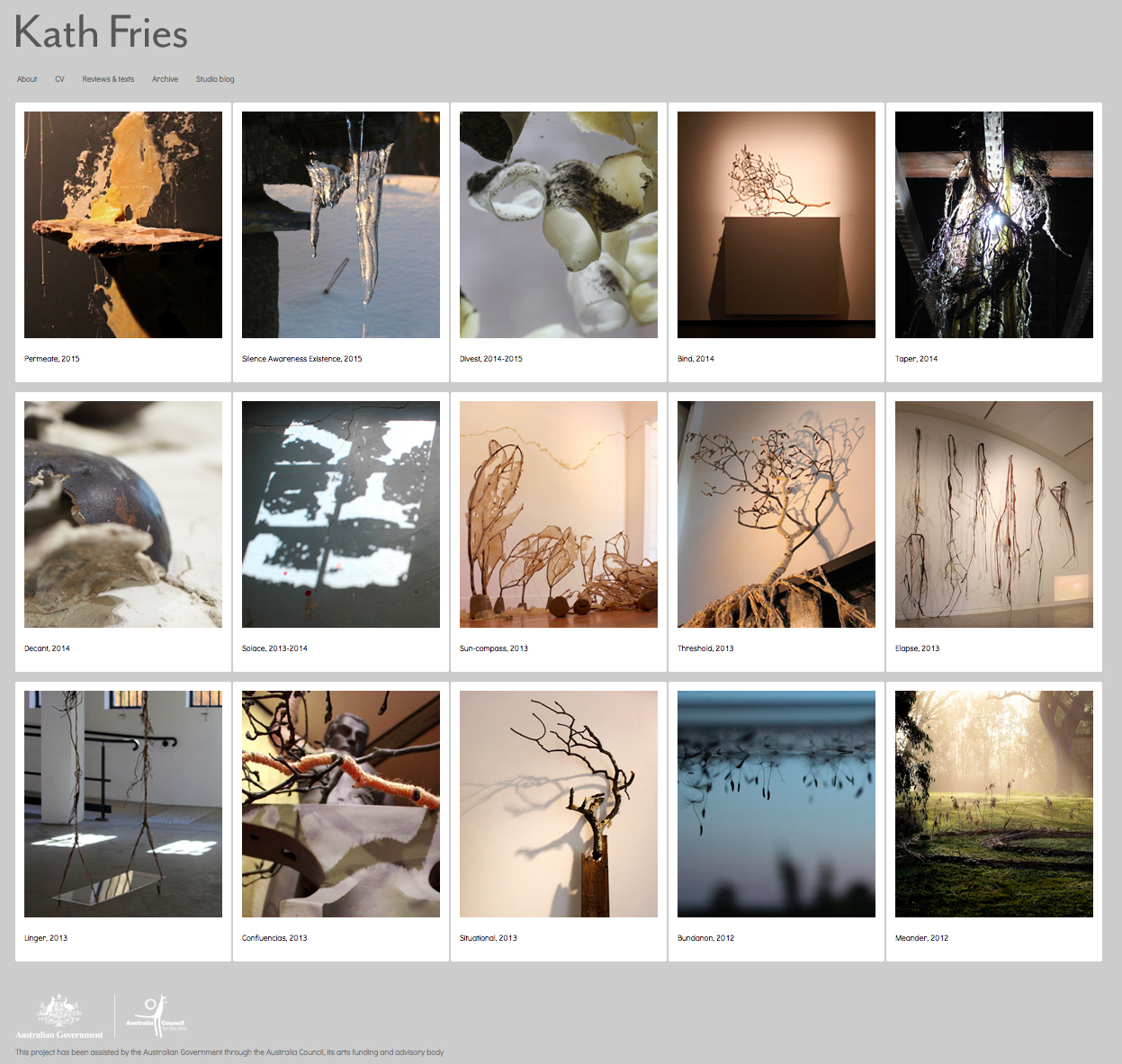
Kath Fries, Bind, 2013, bronze, sisal and beeswax, 52x126x92cm

My bronze sculpture, Bind, has been selected as a finalist for the inaugural Paramor Prize at Casual Powerhouse Arts Centre. This award has been launched in memory of the artist Wendy Paramor (1938-1975) and aims to encourage new ways of seeing, experiencing and interpreting the world around us.

Bind imitates that change is inevitable, despite human persistence at trying to halt its progress. Cast in bronze, the twisting growth of this magnolia branch is permanently paused just on the point of blooming, the small buds are representative of life and its possibility, symbolising of the fleetingness of time. The branch was cast directly into bronze using a ‘lost wax’ technique, which burns the branch from the inside outwards replacing the impermanent wood and fibres with metal, rendering temporal growing shapes into static forms. This casting process demands an act of destruction, so the original living form no longer exists and all that remains is an inert object. Sisal rope  tightly wrapped around the central stem of the branch is sealed with beeswax, physically conveying further attempts at constraining, sealing and holding still the changing nature of the growing branch. As such Bind metaphorically reflects our frequent human endeavours to render permanent that which is impermanent, and the futility of attempting to influence the progression of time.

Finalists: Marian Abboud, 
Tim Andrew, 
Clark Beumont, 
Damien Butler, 
Penelope Cain, 
Carla Cecson, 
Simon Alexander Cook and Geoff Sellman, 
Gary Deirmendjian, 
James Dodd, 
Jacquelene Drinkall, 
Kath Fries, 
Sarah Goffman, 
Tim Gregory, 
Freya Jobbins, 
Yvette Hamilton, 
Joanne Handley 
Ash Keating, 
Karena Keys, 
Rosalind Lemoh, 
Owen Leong, 
Leon Lester, 
Liana Lewis, 
Lorraine Maggs, 
Megan McPherson, 
Louise Paramor, 
Katy B Plummer, 
The Polka Dot Sisters (Sally Atkins and Kate Stewart), 
Diego Ramirez, 
Merri Randell, 
Erica Seccombe, 
Paul Snell, 
Susannah Strati, 
Ioulia Terizi, 
Mimi Tong, 
Frank Trimarchi, 
Undrawing the Line (Zanny Begg), 
Carla and Lisa Wherby, 
Julie Williams, 
Gabriella and Brent Wilson, 
Jason Wing.

Paramor Prize opening invitation, Casula Powerhouse Arts Centre


PARAMOR PRIZE
31 January – 15 March 2015
Casula Powerhouse Arts Centre
1 Powerhouse Road, Casula NSW 2170
(Enter via Shepherd Street Liverpool)
Monday to Sunday 10am - 5pm

Silence Awareness Existence February residency at Arteles Creative Center, Finland


In February I will be joining the Silence Awareness Existence international group residency, at Arteles Creative Centre, Haukijärvi Finland www.arteles.org/sae_residency.html. This residency will enable me to research how our awareness of our sensory engagements with our surroundings are experienced in such an extreme and specific time and place. I plan to create new ephemeral installation work in response to the unique climate and landscape of Finland, working alongside a diverse range of participating international artists whose work also focuses on the themes of silence, awareness and existence.

The Silence Awareness Existence residency takes place in the extreme weather conditions of February, one of the darkest months of the Finnish winter, which is an essential factor of this unique group residency structured to deepen our thinking and practices responding to the sensory impact of time and place. The residency’s themes resonate in my creative process of quiet contemplation and tactile engagement with my surroundings. Working with the site, trace and ephemeral natural materials I will be researching circadian rhythms, how we experience time in relation to sunlight, and how these sensory influences - temperature, low light and muffled sound - can become embodied experiences in art practice.

In several of my recent projects, I've focused on the duration and movement of sunlight and shadows, permeating interior spaces to track a visual, natural awareness of the passage of time. The cold dark snowy winter of February in Finland will be a stark contrast to the hot bright summer Februaries in Sydney, and this will be key to my project. The lack of sunlight in the Finnish winter causes most creatures, even insects like honeybees, to hibernate. Beeswax as material and honeybees as metaphor, feature prominently in my work, and the agricultural farmland around Arteles will be essential to my research about honeybees in Finland. Honeybees communicate the position of the sun through their waggle dances telling other foraging bees flower locations; they are obsessive about sealing up cracks in their hives, and experts at storing honey for the colony’s survival in winter. Like honeybees in winter, humans spend most of their time indoors, sealing themselves into interior sanctuaries protected from harsh external elements.

Much of my work explores how humans are inextricably part of nature; we are fragile and vulnerable, despite our ceaseless efforts to separate and contain nature and natural cycles. I am interested in experiencing this human containment as it manifests in a Finnish winter, when the necessity of keeping nature outdoors becomes truly essential for survival. To some extent the outside environment will always permeate our interior spaces, as sunlight and ice on windows, and draughts through cracks in the walls and around doorways. These uncontainable natural elements will influence how I experience and document my physical and mental adjustments to Finnish winter sensory experiences, which dramatically contrast Sydney’s February summer climate.

I’m looking forward to meeting the other nine international artists on this residency who all work with the themes of silence, awareness and existence in their practices. We'll be  sharing our experiences of the time and place of Arteles in winter, and discussing how it informs our practices. This will be my first overseas residency, my first visit to Finland and first experience of a northern Scandinavian winter!


Ian Potter Cultural Trust recent grants - www.ianpotterculturaltrust.org.au/recent-grants

Thank you to Ian Potter Cultural Trust for their supporting grant to take up this important  overseas professional development opportunity ianpotterculturaltrust.org.au; to Arteles for their resident grant covering half the program fee arteles.org; to the SCA Postgraduate Support Scheme sydney.edu.au/sca for assisting with my field research at  Arteles, which will inform my PhD; and to Arts NSW's Artists' Grant Scheme, a devolved funding program administered by the National Association of the Visual Arts on behalf of the NSW Government visualarts.net.au/nava-grants

I'm going to post updates here on my studio blog while I'm in Finland, so you can read about my experiences and see my Silence Awareness Existence project as it develops. 

Research preparation - YouTube video of honeybees hibernating during winter in Finland (link). Interesting... however beekeepers wouldn't usually open a hive during winter as the honeybee colony will die if exposed to the cold for too long. During winter honeybees hibernate - they don't leave the hive. Instead they all huddle together in the naturally insulated centre of the hive, they survive by eating their stores of honey and vibrating their wings to keep warm. 

Divest installation at Articulate Project Space


Kath Fries, Divest, 2014, beeswax, ash and wooden pillar,
Articulate Project Space, detail view

As part of the group exhibition Articulate Turns Four: Colour, Form, Line, I'm exhibiting one of my Divest installations. This site-responsive work is made of beeswax and ash, interpreting the exhibition's themes of line and form - as the vertical line of the pillar and the cylindrical forms of the beeswax polyps. This work explores uncontainablity and seeping intersections between artifice and nature. Beeswax polyp forms cluster within an upright crevice of the gallery, seemingly seeping outwards to gradually invade the space. These aromatic translucent shapes suggest embodied presence but their surfaces are smattered with ash, which in turn conjures a sense of uneasiness, vulnerability and loss.

Kath Fries, Divest, 2014, beeswax, ash and wooden pillar, 
Articulate Project Space, 280x30x10cm

Colour, Form, Line is a theme-based group show curated by William Seeto for the end-of-year annual exhibition titled Articulate Turns Four. The exhibition theme of colour, form and line sets the context by providing a framework that enables discourse, and offers a means of connecting diverse art practices.

Featuring work by: Lisa Andrew, Elizabeth Ashburn, Clementine Barnes, Lynne Barwick, Linden Braye, Brogan Brunt, Sue Callanan, Andy Chi Yau Chan, Shirley Cho, Clara Chung, Vivienne Dadour, Ella Dreyfus, Judith Duquemin, Edwin Easydorchik, Michele Elliott, Nola Farman, Kath Fries, Brigitta Gallaher, Jane Gavan, Beata Geyer, Anne Graham, Veronica Habib, Yvette Hamilton, Laine Hogarty, Adrian Hall, Barbara Halnan, Sahar Hosseinabadi, Tom Issacs, Melissa Maree, Rose Ann McGreevy, Anne Mosey, Christine Myerscough, Jennifer O’Brien, Sue Pedley, Sergio Plata, Jacek Przybyszewski, Christopher Raymond, Margaret Roberts, Marlene Sarroff, Kevin Sheehan, Andrew Simmons, Sardar Sinjawi, Anke Stacker, Paul Sutton, Jane Burton Taylor, Toni Warburton, Gary Warner, Cecilia White, Elke Wohlfahrt, India Zeghan.

Articulate Project Space
497 Parramatta Rd, Leichhardt NSW
Articulate Turns Four: Colour, Form, Line
Curated by William Seeto
Opening event: 19 December, 6-8pm
Open hours: 11am-5pm, 20-28 December 
(closed 25 & 26 December)

Kath Fries, Divest, 2014, beeswax, ash and wooden pillar, 
Articulate Project Space, detail view