Changing light - Dwindle at the Coal Loader

Kath Fries, Dwindle, 2013, beeswax, branches, bark and thread
Dwindle is being exhibited at the Coal Loader, Waverton in the 2013 North Sydney Art Prize until 5 August.


Dwindle - installation at The Coal Loader

The Coal Loader is an intriguing site where many paths of history intersect. Located on the Waverton peninsula, on the Northern side of Sydney harbour, it was a place of physical and spiritual sustenance for the Cammeraygal people who lived on this peninsula for thousands of years. A large rock carving survives at the site and is central to the new Coal Loader Centre for Sustainability. The Coal Loader operated as a transfer depot for coal, from the 1920s to the 1990s. A large coal stockpile was housed on the elevated platform and the coal was dropped through chutes down into skips in the tunnels beneath, where a railway system took the coal out along the wharf to the vessels in the harbour. Today the site has been transformed into a leading Sustainability Centre. The old industrial structures and historic buildings have been incorporated into community gardens, native bush nursery and regenerated park lands. For the next ten days The Coal Loader will also host the contemporary art exhibition Toward 2020.

Kath Fries, Dwindle, 2013, beeswax, branches, bark and thread, (detail view)

When I first visited the Coal Loader site, I was looking for specific elements that related to human influences on cycles of nature. There were many possibilities, but I decided to focus on just two. In the veggie patch and herb garden I noticed numerous bees working away at collecting pollen. Down the hill, I was interested to learn that the endangered eastern bent-wing bat (a type of Micro-bat) uses the alcoves and coal loading chutes in one of the tunnels as a seasonal nesting site. These tiny furry mammals eat insects and are smaller than the palm of your hand.
My resulting site-responsive installation, Dwindle, is situated in one of the historic buildings at the Coal Loader next to the veggie patch and herb garden. Made from beeswax, branches and thread; the installation arches overhead, drawing the visitors attention to the architecture of the building and leading outside into the trees, escarpment and garden. The work's sense of fragility and tenuous interconnection is enhanced by the winter sunlight illuminating thin sections of beeswax, held by contorted twigs swaying gently in the breeze. 

Kath Fries, Dwindle, 2013, beeswax, branches, bark and thread, (detail view)

Bats and bees are thriving at the Coal Loader site, but further afield both species are being adversely affected by the use of pesticides, which has dire implications for sustaining agriculture and global human food production. 'Dwindle' is a term that has been used historically to describe instances of honeybee colony collapse disorder (CCD). I am interested in our frequent lack of awareness towards the nuances, complexities and interdependencies within nature. My installation, Dwindle, is a metaphoric reflection of humanity’s tunnel vision through the complex cyclic nuances of bats and bees, and nature’s finite ability to adapt to human impact.


Kath Fries, Dwindle, 2013, beeswax, branches, bark and thread, (detail view)

Colony Collapse Disorder (CCD) is a phenomenon amongst European Honeybees, in which worker bees from a beehive abruptly disappear. Although such disappearances have occurred throughout the history of apiculture, and were known as 'Dwindles' (such as Spring Dwindle and Fall Dwindle Disease), the syndrome was renamed Colony Collapse Disorder in late 2006 in conjunction with a drastic rise in the number of disappearances of Western honeybee colonies in North America and Europe. Increased use of neonicotinoid pesticides - the most widely used pesticides in the world, has roughly tracked with rising bee deaths since 2005. Neonicotinoids affect bees through toxic dust, pollen, and nectar; making the bees immune system weak and their behaviour lethargic resulting in them not returning to the hive. CCD is compounded by a combination of factors including mites, parasites, and viruses, genetics, habitat loss, environmental change-related stress, malnutrition, and migratory beekeeping. Many agricultural crops worldwide are pollinated by European honey bees. In April 2013, the European Union passed legislation banning the use of several neonicotinoids for the following two years, in an attempt to stop bee populations from declining further. 
Globally about 90% of plants rely on bees to transfer pollen for fertilisation and reproduction. European Honeybee pollination is responsible for more than 30% of all food consumed by humans around the world. If these bees all became effected by CCD, then a third of our food supply will also be lost and consequently human population could not be sustained at its current level.

Kath Fries, Dwindle, 2013, beeswax, branches, bark and thread, (detail view)

We may need to teach ourselves about the 'bats and the bees' if we want to keep feeding ourselves... 

Kath Fries, Dwindle, 2013, beeswax, branches, bark and thread,
280 x 140 x 300 cm

Bats are necessary for keeping many types of crop-eating insect populations from swarming, and their populations are becoming dramatically reduced due to the widespread use of pesticides on our crops. All bats play a vital part in assisting the seeding of bushland and the regeneration of rainforests. They can be very successful at keeping down insect pests if left to populate an area. Bats are protected in Australia and have inhabited this continent for many thousand years. Despite popular concern, they actually pose minimal risk to humans, providing you leave them alone and do not have physical contact with them. Studies show that bats are particularly sensitive to pesticides, but these threatened animals are generally ignored in pesticide risk assessment procedures. Current widespread immunosuppression among bats is believed to be caused by pesticides. In both bats and bees pesticides weaken the immune system in both bees and bats, allowing infections to take hold.

References and further reading:

Kath Fries, Dwindle, 2013, beeswax, branches, bark and thread, (detail view)

Dwindle is being exhibited in Toward 2020 
The North Sydney Art Prize

27 July - 5 August 2013
The Coal Loader
2 Balls Head Drive, Waverton, NSW


Toward 2020 - The North Sydney Art Prize, event invitation

"haunting installation" - Linger, 2013


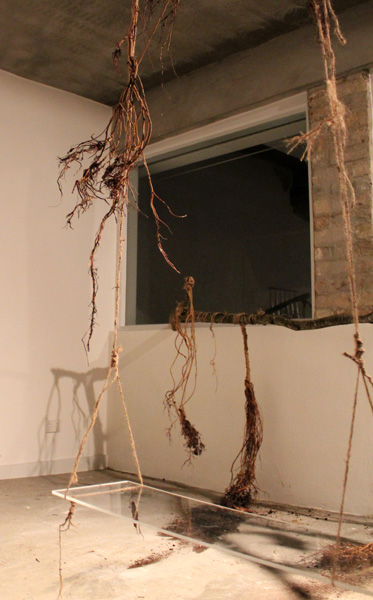
Kath Fries, Linger, 2013, Ficus hillii aerial roots, twine, branches, clay, soil and perspex
(detail view) 

"The focus of Mapping Memory, is an exhibition curated around the concept of where we locate our memories, how these are passed on or preserved, how our personal and collective cultural identities are informed by histories encapsulated in various sites or objects, and how they shape our present and future.  In particular, this exhibition regards the significance of geographical, architectural, spiritual, cultural, material and imaginary sites where these personal and collective memories may reside.  The intention is not one of sentimentality or nostalgia but to recognise pathways to understanding our identities.  As Pierre Nora writes in Realms of Memory (1984), “the need for memory is the need for history”. The artists in Mapping Memory draw attention to various material or spatial realms in which memory can be projected and embodied...

Kath Fries’ haunting installation also emphasises the environment as its point of departure. Linger, which is made from vertical roots from a fig tree adjacent to the Incinerator, contemplates how memories are deeply ‘rooted’ within a particular locale.  Their grasp and permeation into an area is enduring and the land becomes a storehouse of memory; a layered document of tangible and intangible history.

...Within a subject that is vast, layered, disputed, complex and changing, Mapping Memory displays a dedicated focus.  The exhibition demonstrates the various ways in which memory is so closely linked to objects and sites that in turn immediately affects us as individuals, cultures and societies, and directly influence the formation and understanding of our personal and collective identities."

(Venita Poblocki, Curator, extracts from Mapping Memory catalogue)


Kath Fries, Linger, 2013, Ficus hillii aerial roots, twine, branches, clay, soil and perspex
View looking down through studio windows above the gallery. 

Kath Fries, Linger, 2013, Ficus hillii aerial roots, twine, branches, clay, soil and perspex
dimensions approximately 540x400x220cm 

Kath Fries, Linger, 2013, Ficus hillii aerial roots, twine, branches, clay, soil and perspex
dimensions approximately 540x400x220cm 

Linger is currently being exhibited in Mapping Memory, a group exhibition curated by Venita Poblocki at the Willoughby Incinerator Art Space; alongside works by Cyrus Tang, Tessa Zettel & Karl Khoe (Makeshift), Thea Weiss, Tim Bruniges & Sarah Mosca, Megan Cope and Nick Fintan. 

'Linger' - installation for Mapping Memory, at the Incinerator Art Space

Kath Fries, Linger, 2013, Ficus hillii aerial roots, twine, branches, clay, soil and perspex
dimensions approximately 540x400x220cm 

Linger explores metaphors of searching for a sense of belonging and the fragility of childhood memories. Aerial roots (collected from a fig tree growing outside the gallery) hang overhead entangled with soil, debris and twine. Suspended in the middle is a simple homemade swing - a transparent plank, like a window or portal into one's memory. The Incinerator was initially used to combust suburban waste, now a contemporary art space the building still sits partly underground and partly hanging off the side of a steep hill; situated within this structure Linger amplifies the site's atmosphere of transience, dislocation and impermanence.

Kath Fries, Linger, 2013, Ficus hillii aerial roots, twine, branches, clay, soil and perspex(detail view) total dimensions approximately 540x400x220cm

Kath Fries, Linger, 2013, Ficus hillii aerial roots, twine, branches, clay, soil and perspex(detail view) total dimensions approximately 540x400x220cm

Kath Fries, Linger, 2013, Ficus hillii aerial roots, twine, branches, clay, soil and perspex
(detail view) total dimensions approximately 540x400x220cm

Kath Fries, Linger, 2013, Ficus hillii aerial roots, twine, branches, clay, soil and perspex
(detail view) total dimensions approximately 540x400x220cm

Kath Fries, Linger, 2013, Ficus hillii aerial roots, twine, branches, clay, soil and perspex
dimensions approximately 540x400x220cm

"... memory is a limitless subject in art and culture itself, being intrinsic to its very materialisation." (Ian Farr)


Kath Fries, Linger, 2013, Ficus hillii aerial roots, twine, branches, clay, soil and perspex
dimensions approximately 540x400x220cm

Kath Fries, Linger, 2013, Ficus hillii aerial roots, twine, branches, clay, soil and perspex
(detail view) total dimensions approximately 540x400x220cm

Kath Fries, Linger, 2013, Ficus hillii aerial roots, twine, branches, clay, soil and perspex
(detail view) total dimensions approximately 540x400x220cm

Kath Fries, Linger, 2013, Ficus hillii aerial roots, twine, branches, clay, soil and perspex
(detail view) total dimensions approximately 540x400x220cm

Kath Fries, Linger, 2013, Ficus hillii aerial roots, twine, branches, clay, soil and perspex
(detail view) total dimensions approximately 540x400x220cm

Kath Fries, Linger, 2013, Ficus hillii aerial roots, twine, branches, clay, soil and perspex
dimensions approximately 540x400x220cm


Linger is currently being exhibited in Mapping Memory, a group exhibition curated by Venita Poblocki at the Willoughby Incinerator Art Space; alongside works by Cyrus Tang, Tessa Zettel & Karl Khoe (Makeshift), Thea Weiss, Tim Bruniges & Sarah Mosca, Megan Cope and Nick Fintan. 

Mapping Memory exhibition invitation, Willoughby Council Incinerator Art Space


A swing in the studio - 'Linger' work in progress

Kath Fries, Work in progress Incinerator Studio, 2013
Ficus hillii aerial roots, twine, branches, clay, soil and perspex

Kath Fries, Work in progress Incinerator Studio, 2013
Ficus hillii aerial roots, twine, branches, clay, soil and perspex

I'm currently working on a site-responsive installation about memory and connection to place at the Willoughby Incinerator Art Space. Initially I planned to use sheets of perspex suspended horizontally so they would seemingly hover overhead, with soil sitting on top that you viewed by looking up from underneath. But after playing with with different ways of tying and suspending the perspex, I hung one like a swing. This fragile backyard swing instantly conjured nostalgic childhood memories. With this new focal point, of the swing surrounded by aerial roots inside a building that is partly underground and partly hanging off the side of a steep hill, my installation, Linger, is gradually forming a narrative of transient childhood memories and searching for connections to place.


Kath Fries, Work in progress Incinerator Studio, 2013
Ficus hillii aerial roots, twine, branches, clay, soil and perspex

Kath Fries, Work in progress Incinerator Studio, 2013
Ficus hillii aerial roots, twine, branches, clay, soil and perspex

Kath Fries, Work in progress Incinerator Studio, 2013
Ficus hillii aerial roots, twine, branches, clay, soil and perspex

Kath Fries, Work in progress Incinerator Studio, 2013
Ficus hillii aerial roots, twine, branches, clay, soil and perspex

Kath Fries, Work in progress Incinerator Studio, 2013
Ficus hillii aerial roots, twine, branches, clay, soil and perspex
Kath Fries, Linger - work in progress Incinerator Studio, 2013
Ficus hillii aerial roots, twine, branches, clay, soil and perspex

Kath Fries, Linger - work in progress Incinerator Studio, 2013
Ficus hillii aerial roots, twine, branch,

Kath Fries, Linger - work in progress Incinerator Studio, 2013
Ficus hillii aerial roots, twine, branches, clay, soil and perspex

Kath Fries, Linger - work in progress Incinerator Studio, 2013
Ficus hillii aerial roots, twine, branches, clay, soil and perspex

Kath Fries, Linger - work in progress Incinerator Studio, 2013
Ficus hillii aerial roots, twine, branches, clay, soil and perspex


Kath Fries, Linger - work in progress Incinerator Studio, 2013
Ficus hillii aerial roots, twine, branches, clay, soil and perspex

Linger will be exhibited in the Mapping Memory group exhibition, curated by Venita Poblocki at the Willoughby Incinerator Art Space, 12 June - 17 July 2013, alongside works by Cyrus Tang, Tessa Zettel & Karl Khoe (Makeshift), Thea Weiss, Tim Bruniges & Sarah Mosca, Megan Cope and Nick Fintan. link to preview artworks